
What Is Roofing Adhesive? Properties, Performance, and Uses
TL;DR Adhesive Summary
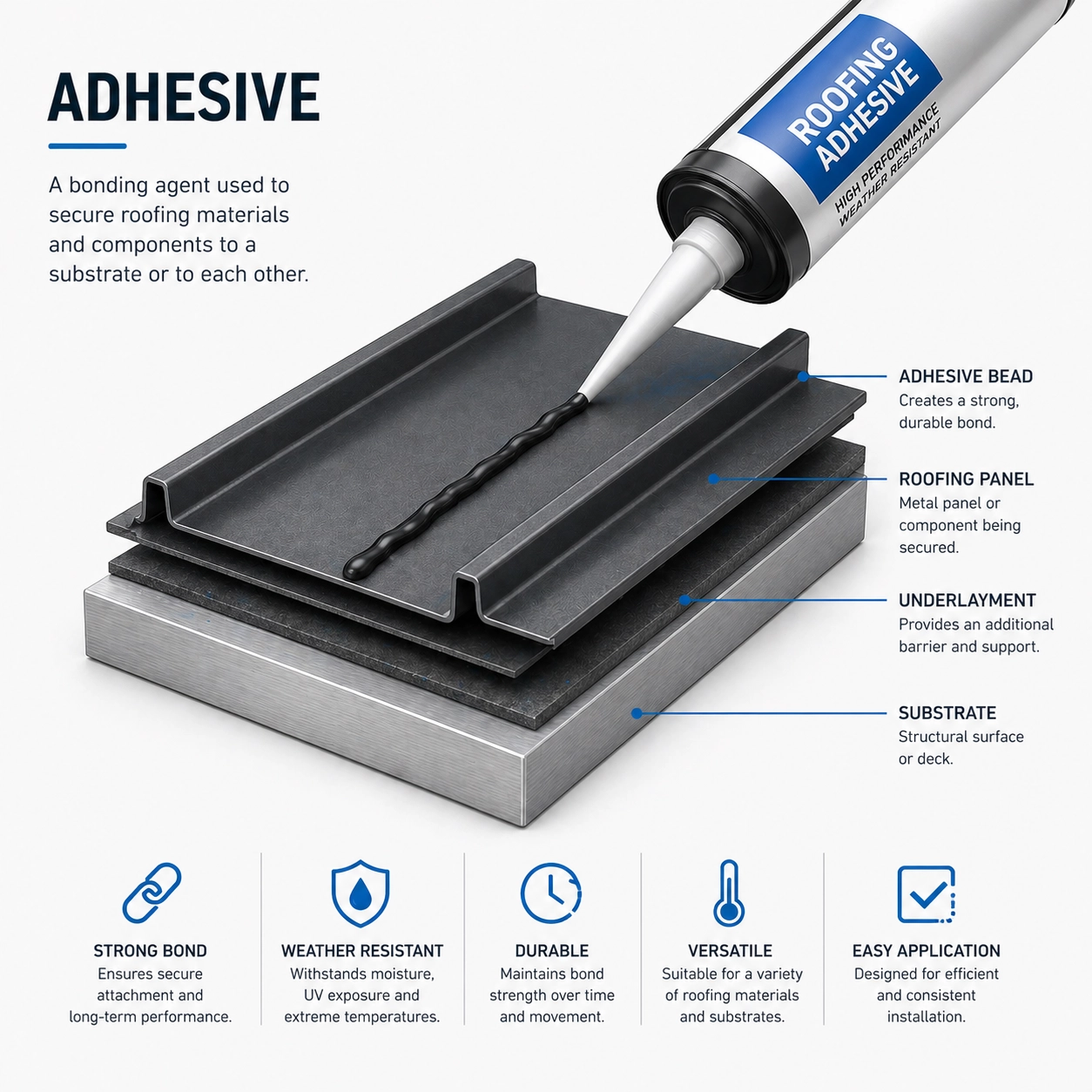
Adhesive is a bonding agent used to secure roofing materials such as membranes, insulation, or shingles to roof decks or other substrates. Its effectiveness directly impacts roof durability, weather resistance, and long-term performance by preventing material separation or wind uplift. Selecting the right adhesive for specific materials and climate conditions is critical, as improper choice or application can lead to premature roof failure or costly repairs.
How Roofing Adhesive Enhances Installation Quality, Durability, and Weather Resistance
Adhesive, in roofing systems, is a specialized bonding agent used to secure roofing materials such as membranes, insulation, shingles, or flashing components to substrates or to each other. Unlike mechanical fasteners, adhesives create a continuous bond across surfaces, distributing loads evenly and minimizing penetrations that could compromise water resistance. Adhesives are formulated for compatibility with various roofing assemblies, including low-slope and steep-slope roofs, and are selected based on substrate type, environmental exposure, and required performance characteristics.
Functionally, adhesives enhance the structural integrity of the roof by providing wind uplift resistance, improving waterproofing at seams and terminations, and accommodating thermal movement without compromising the bond. Their application is critical in areas where mechanical fastening is impractical, such as at eaves, ridges, or around complex roof geometries. Adhesives are also essential in fully adhered membrane systems, where they help maintain continuous coverage and prevent water infiltration, snow intrusion, and air leakage. Their use supports efficient water drainage and snow shedding by maintaining smooth, uninterrupted roof surfaces, contributing to the overall durability and performance of the roofing assembly.
How Roofing Adhesive Is Evaluated for Roofing Performance
Roofing adhesive is evaluated for roofing performance based on its ability to provide durable, weather-resistant bonding between roofing materials, particularly in applications such as flat roofs where mechanical fasteners may be less effective or unsuitable. Professionals assess roofing adhesive by examining its compatibility with various substrates, resistance to temperature fluctuations, UV exposure, and moisture, as well as its capacity to maintain adhesion over the expected roofing adhesive lifespan. Field performance is often verified through adhesion tests, peel strength measurements, and observation of long-term durability under real-world conditions.
The benefits of roofing adhesive, such as reduced risk of punctures and improved wind uplift resistance compared to roofing nails, are weighed against potential roofing adhesive problems like improper curing, incompatibility with certain membranes, or susceptibility to chemical degradation. Cost and installation requirements are also considered, as some adhesives may require specific environmental conditions or application techniques to achieve optimal performance. Ultimately, roofing professionals select and evaluate roofing adhesive based on its proven track record, manufacturer specifications, and its ability to meet the demands of the specific roofing system and climate.
Overview & Key Considerations
What Is Adhesive
Why Adhesive Matters
Benefits of Adhesive
ENHANCED WEATHER RESISTANCE
Adhesives create continuous bonds that help roofing materials resist wind uplift, water infiltration, and severe weather conditions.
REDUCED SYSTEM WEIGHT
Using adhesives eliminates the need for mechanical fasteners, reducing overall roof assembly weight and structural load.
IMPROVED CORROSION RESISTANCE
Adhesives prevent direct metal-to-metal contact, minimizing the risk of corrosion in metal roofing assemblies.
INCREASED INSTALLATION COMPATIBILITY
Adhesives enable secure attachment of diverse roofing materials, supporting compatibility with various substrates and membrane types.
Limitations of Adhesive
TEMPERATURE SENSITIVITY
Adhesive bond strength and curing can degrade significantly in extreme cold or heat, impacting long-term roof performance.
MOISTURE VULNERABILITY
Exposure to moisture during application or service life can compromise adhesive integrity, leading to premature material separation.
CHEMICAL COMPATIBILITY
Certain adhesives are incompatible with specific roofing membranes or substrates, causing chemical degradation or bond failure.
AGING AND UV DEGRADATION
Many roofing adhesives lose flexibility and adhesion over time due to ultraviolet exposure and natural aging processes.
Common Adhesive Problems
UV-INDUCED DEGRADATION
Prolonged UV exposure causes adhesive breakdown, leading to membrane separation and increased risk of water infiltration.
CHEMICAL INCOMPATIBILITY
Adhesive reacts adversely with certain roofing materials, resulting in bond failure and premature membrane detachment.
THERMAL CYCLING DAMAGE
Repeated expansion and contraction from temperature fluctuations cause adhesive cracking, compromising long-term roof integrity.
MOISTURE-TRIGGERED FAILURE
Trapped moisture beneath adhesive layers accelerates loss of adhesion, promoting blistering and localized roof leaks.
Adhesive Quick Facts
Use Cases for Adhesive
COLD WEATHER APPLICATION
Adhesive is essential for securing membrane roofing materials in cold climates where mechanical fasteners may cause thermal bridging or leaks.
LOW-SLOPE ROOF SYSTEMS
Adhesive is used to fully bond single-ply membranes to substrates on low-slope roofs, ensuring wind uplift resistance and watertightness.
LIGHTWEIGHT STRUCTURES
Adhesive enables attachment of insulation and membranes without adding significant weight, making it ideal for roofs with limited structural capacity.
SEAMLESS DESIGN GOALS
Adhesive allows for continuous, fastener-free surfaces, supporting modern architectural designs that require clean lines and minimal penetrations.