
What Is an Asian Style Roof? Structure, Design, and Performance
TL;DR Asian traditional style Summary
Asian traditional style refers to distinctive roof types found across Asia, characterized by sweeping curves, layered eaves, and ornate detailing designed for effective rainwater drainage and climate adaptation. These roof geometries matter because their steep pitches and overhangs help manage heavy rainfall, reduce solar gain, and protect building envelopes in diverse weather conditions. When considering Asian traditional style roofs, structural complexity and specialized craftsmanship can increase installation costs and maintenance requirements compared to simpler roof types.
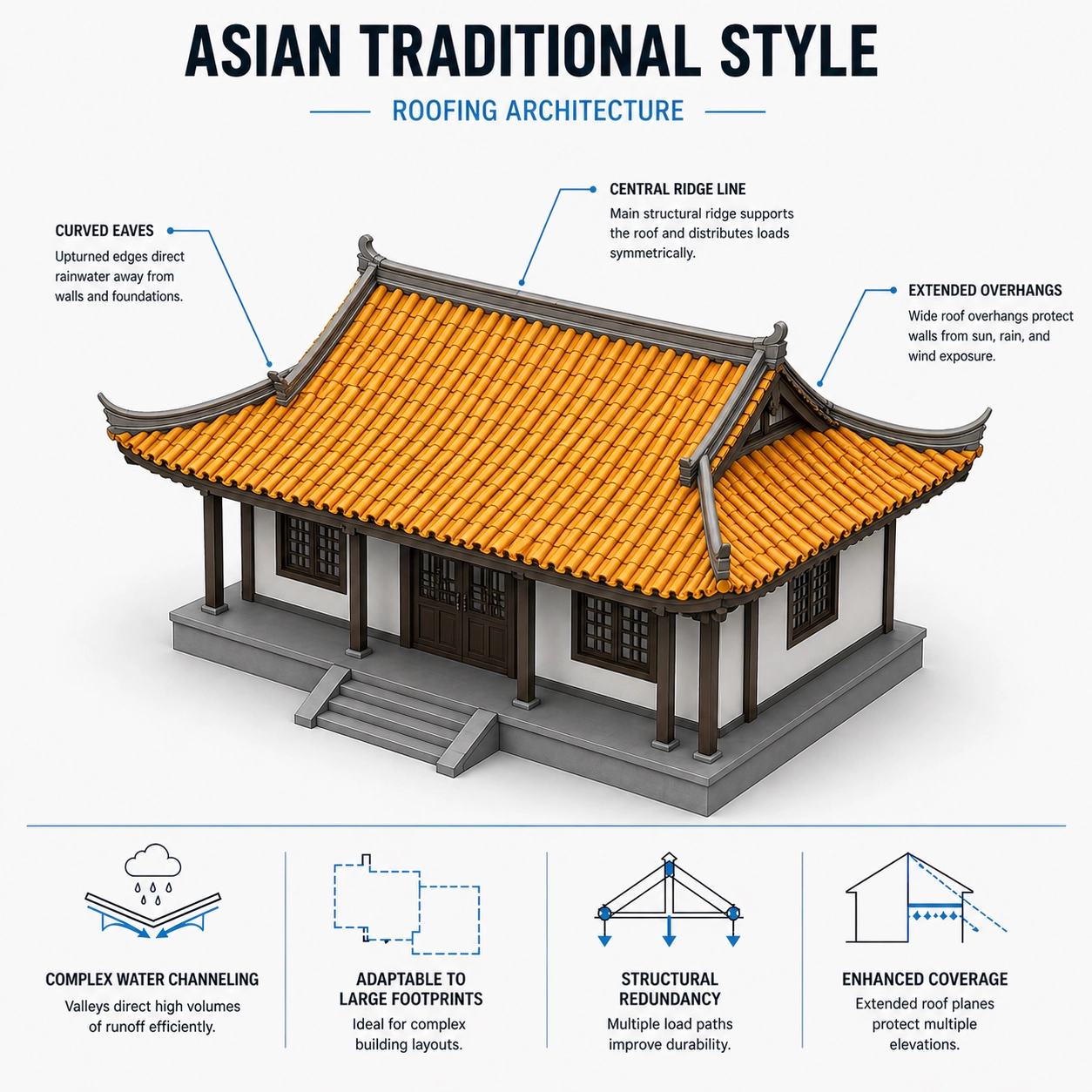
How Asian Style Roofs Enhance Drainage, Wind Resistance, and Performance in Tropical Climates
Asian traditional style refers to a category of roofing systems characterized by distinctive, region-specific geometries and construction methods found throughout East and Southeast Asia. These roofs typically feature pronounced, sweeping slopes with curved eaves and ridges, often incorporating multiple tiers or upturned corners. The structure is commonly supported by timber framing, with roof coverings made from materials such as clay tiles, wooden shingles, or thatch, depending on local tradition and climate.
Functionally, Asian traditional style roofs are engineered for efficient water drainage and snow shedding, thanks to their steep roof pitch and extended eaves. The pronounced overhangs protect walls and foundations from rain, while the curved geometry enhances wind resistance by deflecting gusts and reducing uplift forces. The multi-layered design also contributes to thermal regulation and structural efficiency, distributing loads evenly across the supporting framework.
These roofing systems are predominantly used in temples, palaces, and residential buildings throughout countries like China, Japan, Korea, and Thailand. Their application is driven by both environmental considerations—such as monsoon rains and heavy snowfall—and cultural aesthetics, resulting in roofs that are both functional and architecturally significant.
How Asian Traditional Style Roof Performance Is Evaluated in Roof Design
Asian style roof performance is evaluated by examining how its distinctive design elements—such as sweeping curves, extended eaves, and layered rooflines—address key functional requirements in various climates. Roofing professionals assess the slope and overhangs for their effectiveness in shedding heavy rain, a critical factor in tropical regions where asian traditional style roof drainage and water management are essential. The roof’s structure is also analyzed for wind resistance, as the interlocking tiles or shingles and robust framing typical of asian traditional style roofs help withstand high winds and typhoons.
In practice, the evaluation of an asian style roof includes reviewing its ability to handle structural loads, promote ventilation, and provide thermal comfort. Professionals consider how the roof’s geometry and materials contribute to durability and longevity, especially compared to modern roof types. The benefits of an asian traditional style roof—such as natural cooling, efficient rainwater runoff, and resilience in severe weather—are weighed against local building codes, climate demands, and architectural compatibility. Ultimately, the performance of an asian traditional style roof is verified through a combination of design review, material selection, and real-world exposure, ensuring it meets both aesthetic and functional expectations in its intended environment.
Overview & Key Considerations
What Is Asian traditional style
Why Asian traditional style Matters
Benefits of Asian traditional style
COMPLEX ROOF GEOMETRY
Asian traditional style roofs feature multi-tiered, curved planes that enhance architectural interest and structural complexity.
ENHANCED WEATHER SHEDDING
Steep slopes and extended eaves efficiently direct rainwater away from the structure, reducing water intrusion risks.
INTEGRATED VENTILATION
Distinctive ridge and eave configurations promote natural airflow, supporting moisture control and interior comfort.
USABLE PERIMETER SPACE
Wide overhanging eaves create sheltered exterior zones, increasing functional outdoor space and protecting building facades.
Limitations of Asian traditional style
SEISMIC VULNERABILITY
Traditional Asian roof structures with heavy, layered tiles and extended eaves are susceptible to damage in earthquake-prone regions.
SNOW LOAD LIMITATIONS
Low-slope, wide-eaved Asian traditional roofs are structurally challenged by heavy snow accumulation in cold climates.
DRAINAGE CHALLENGES
Complex, multi-tiered roof geometries can impede efficient water runoff, increasing risk of localized ponding and moisture intrusion.
WIND UPLIFT RISK
Ornate ridge decorations and broad overhangs on Asian traditional roofs can increase vulnerability to wind uplift and storm damage.
Common Asian traditional style Problems
COMPLEX DRAINAGE PATHS
Intricate roof geometry in Asian traditional style often leads to water ponding and localized drainage failures during heavy rainfall.
EAVES WIND UPLIFT
Extended eaves and ornate overhangs are highly susceptible to wind uplift, increasing the risk of structural detachment in storms.
SNOW LOAD ACCUMULATION
Curved and multi-tiered roof profiles can trap snow, causing excessive localized snow loads and potential structural stress or collapse.
SEISMIC STRUCTURAL STRESS
Heavy, layered roof assemblies in Asian traditional style can amplify seismic forces, increasing the risk of rafter or beam failure.
Asian traditional style Quick Facts
Use Cases for Asian traditional style
MONSOON CLIMATE PERFORMANCE
Asian traditional style roofs are ideal for regions with heavy seasonal rainfall, as their steep slopes enable rapid water runoff.
CULTURAL HERITAGE RESTORATION
This roof type is essential for restoring temples, pagodas, and historic homes to preserve authentic Asian architectural aesthetics.
EARTHQUAKE-RESISTANT DESIGN
Asian traditional style roofs often use flexible timber framing, making them suitable for seismic zones requiring resilient roof structures.
VENTILATED ATTIC SPACES
The pronounced eaves and layered construction of Asian traditional style roofs support natural ventilation and cooling in hot, humid climates.