
What Is Attic Space? Function and Role in Roofing Systems
Attic Overview: Role, Energy Efficiency & Roof Longevity
An attic is the enclosed space located directly beneath a roof, typically above the ceiling of the top floor. Attics matter because they play a critical role in regulating building temperature, moisture, and ventilation, directly impacting energy efficiency and roof durability. Poorly designed or ventilated attics can lead to condensation, mold growth, and premature roof failure, making proper integration essential for long-term performance.
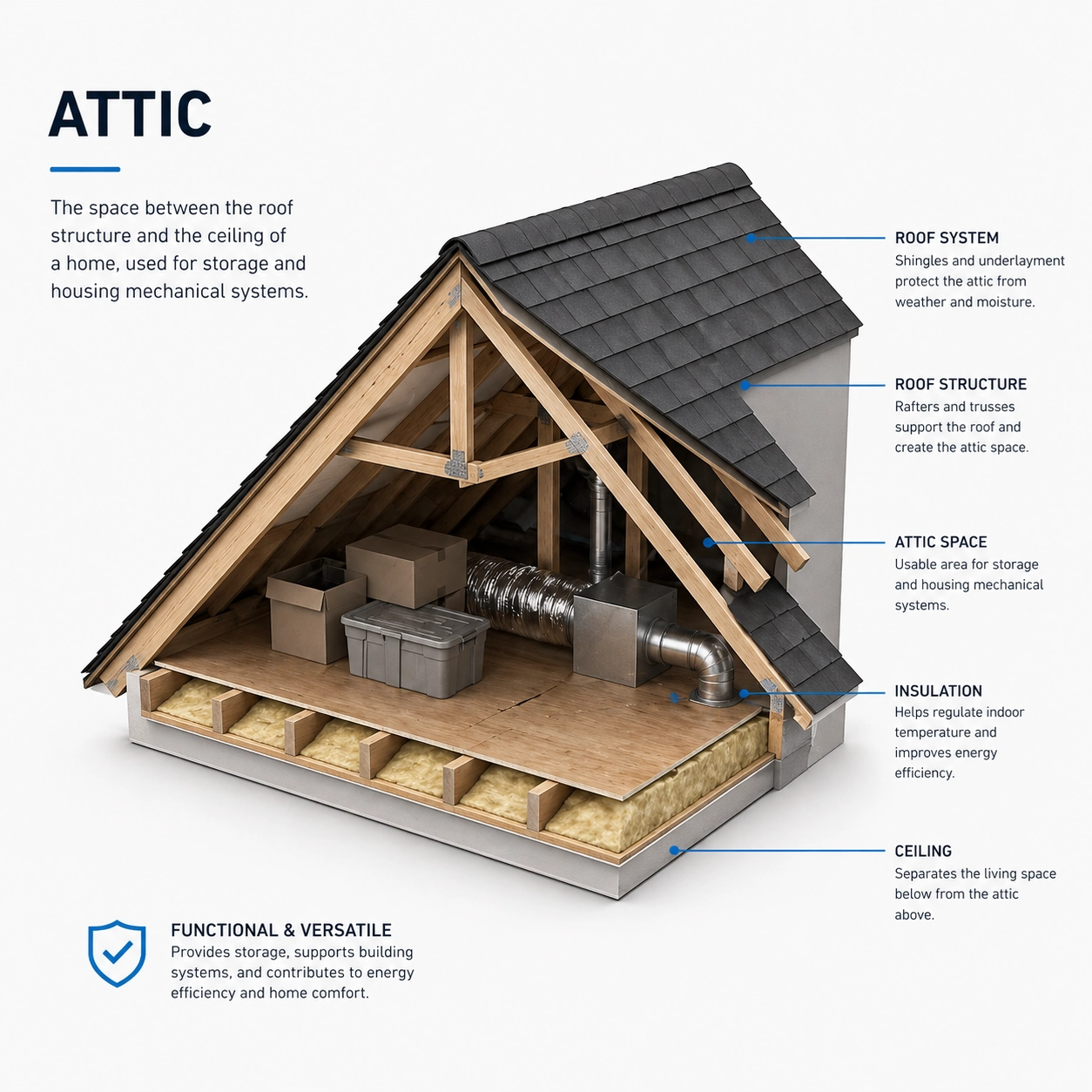
How Attic Space Influences Roof Ventilation, Insulation, and Moisture Control
Attic refers to the enclosed space located directly beneath the roof structure and above the ceiling of the topmost occupied floor in a building. Architecturally, an attic is defined by the geometry of the roof—typically bounded by the roof slopes, ridge, and eaves—and is formed when the roof pitch creates sufficient vertical clearance between the ceiling joists and the underside of the roof deck. The structural configuration of the attic depends on the type of roof framing, such as rafters or trusses, and the overall roof design.
Functionally, the attic serves as a buffer zone that can moderate temperature fluctuations between the conditioned interior and the external environment. Properly ventilated attics help manage moisture, reduce the risk of condensation, and contribute to the longevity of roofing materials by preventing ice dam formation and promoting snow shedding. The attic space may be used for mechanical systems, insulation, or storage, and in some cases, finished as habitable space if the roof pitch and structural design allow. Attics are integral to the performance and efficiency of sloped roof assemblies, influencing water drainage, wind resistance, and overall building durability.
How Attic Space Is Evaluated in Roofing Systems
Attic space is evaluated in roofing systems based on its function, integration, and impact on overall roof performance. Roofing professionals assess the attic’s placement and configuration to ensure it provides adequate separation between the living area and the roof deck, which is essential for thermal regulation and moisture control. The evaluation includes verifying that the attic is properly ventilated to prevent attic ventilation problems, such as heat buildup and condensation, which can lead to attic moisture issues and compromise roofing materials.
Assessment of attic space also involves examining insulation levels and installation quality, as proper attic insulation benefits both energy efficiency and roof longevity. Inspectors look for signs of inadequate or improperly installed insulation, which can result in heat loss, ice dam formation, or increased energy costs. The attic installation process is reviewed to confirm that access points, vapor barriers, and air sealing are correctly implemented, supporting the attic’s function in a roof system.
Professionals distinguish attic space from other areas like crawl spaces by evaluating height, accessibility, and intended use, as attic vs crawl space differences affect ventilation and maintenance strategies. Regular inspection of attic space is critical for identifying early signs of structural or moisture-related issues, ensuring the attic continues to support the roof’s performance and the building’s overall health.
Overview & Key Considerations
What Is Attic
Why Attic Matters
Benefits of Attic
VENTILATION CONTROL
An attic enables balanced airflow beneath the roof deck, reducing moisture buildup and preventing condensation-related damage.
THERMAL BUFFER
The attic acts as an insulating barrier, minimizing heat transfer between the living space and the exterior environment.
STRUCTURAL INTEGRATION
An attic provides a dedicated space for mechanical systems and utilities, preserving roof structure integrity and accessibility.
FAILURE PREVENTION
Properly designed attics help prevent ice dam formation and roof deck deterioration by supporting effective insulation and ventilation.
Limitations of Attic
VENTILATION DEPENDENCY
Attic performance is highly dependent on proper ventilation, making it vulnerable to moisture buildup and heat accumulation if airflow is inadequate.
INSULATION SENSITIVITY
Attic effectiveness relies on correct insulation placement and continuity, with gaps or compression leading to significant energy loss.
MOISTURE INTRUSION RISK
Attics are prone to condensation and mold growth if vapor barriers or roof underlayments fail or are improperly installed.
STRUCTURAL LOAD LIMITS
Attics are not typically designed for heavy storage or occupancy, and overloading can compromise roof framing integrity.
Common Attic Problems
VENTILATION FAILURE
Inadequate attic ventilation leads to trapped moisture, causing condensation, mold growth, and accelerated roof deck deterioration.
INSULATION GAPS
Improperly installed or missing attic insulation creates thermal bridging, resulting in ice dam formation and increased energy loss.
AIR LEAKAGE PATHS
Unsealed attic penetrations allow conditioned air to escape, promoting condensation and reducing overall roof system performance.
STRUCTURAL SAGGING
Excessive attic moisture or pest infestation can weaken framing members, leading to sagging rooflines and compromised structural integrity.
Attic Quick Facts
Use Cases for Attic
VENTILATION CONTROL
Attics provide a dedicated space for installing passive or active ventilation systems to regulate roof temperature and moisture buildup.
INSULATION PLATFORM
Attics serve as the primary location for adding thermal insulation above living spaces, improving building energy efficiency and comfort.
MOISTURE BARRIER LOCATION
Attics allow for the placement of vapor barriers and air sealing measures to prevent condensation and mold within the roofing system.
EQUIPMENT ACCESS
Attics offer accessible space for routing HVAC ducts, electrical wiring, and plumbing without penetrating the main roof structure.