
What Is Base Ply Roofing Sheet? Properties, Performance, and Uses
TL;DR Base-ply sheet Summary
A base-ply sheet is a foundational layer of roofing material, typically made from fiberglass or organic felt, used in multi-ply roof assemblies. Because it provides initial waterproofing and reinforcement, its quality directly affects the roof’s durability and resistance to leaks. Proper selection and installation of the base-ply sheet are critical, as inadequate materials or workmanship can lead to premature roof failure, especially in harsh climates.
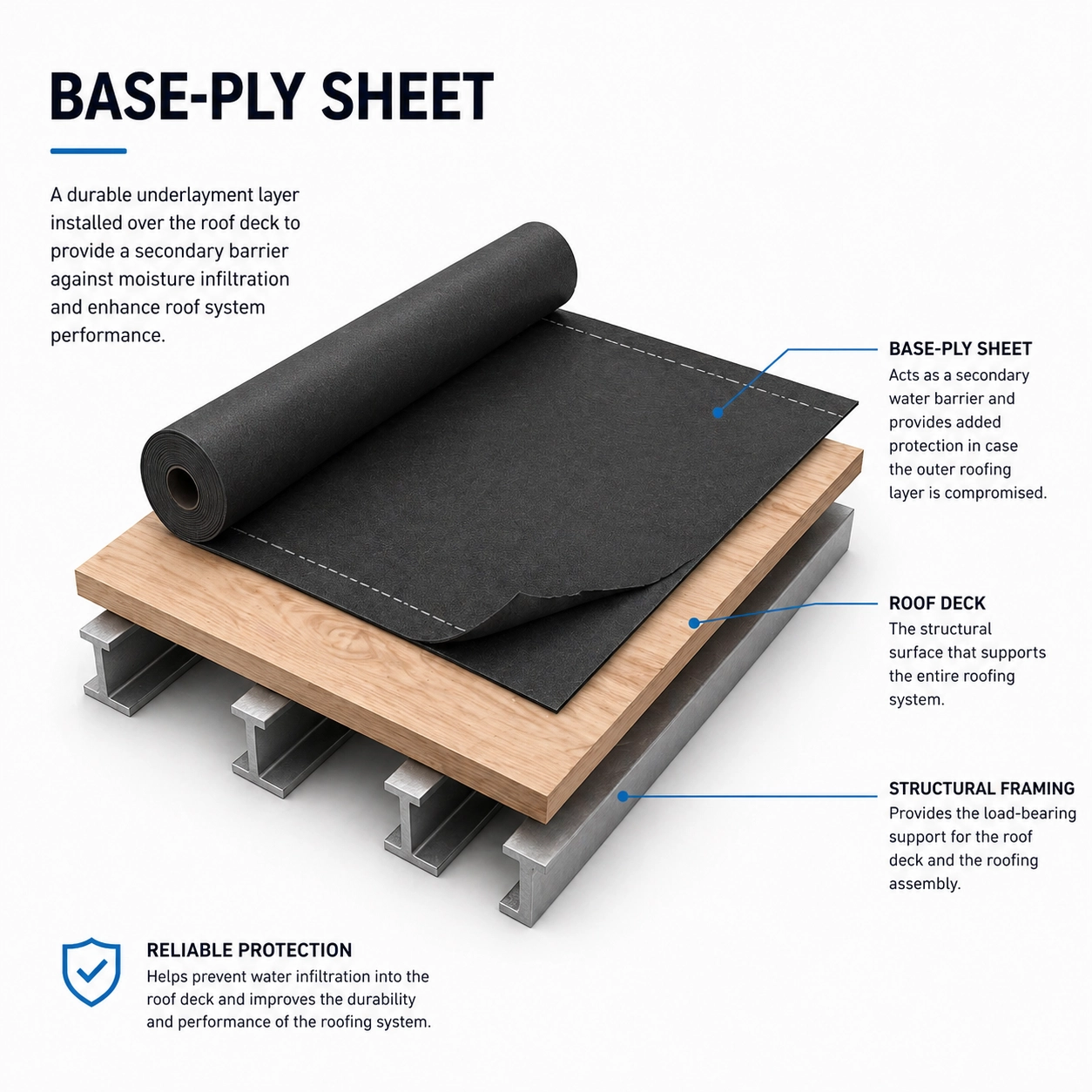
How Base Ply Roofing Sheets Enhance Roof Durability and System Performance
Base-ply sheet is a foundational layer in multi-ply roofing systems, typically used in built-up roofs (BUR) and modified bitumen assemblies. It is a flexible, asphalt-impregnated sheet—often composed of fiberglass or polyester reinforcement—installed directly over the roof deck or insulation. The base-ply sheet serves as the initial membrane layer, providing a stable substrate for subsequent plies and surfacing materials. Its geometry allows it to conform to the roof’s pitch, slopes, ridges, and eaves, ensuring continuous coverage and minimizing gaps that could compromise waterproofing.
Functionally, the base-ply sheet enhances the roof’s resistance to water infiltration, wind uplift, and thermal movement. By acting as a barrier, it helps direct water toward drainage points and away from vulnerable areas such as laps, penetrations, and terminations. The sheet’s reinforcement improves dimensional stability and structural efficiency, reducing the risk of splitting or wrinkling under mechanical or thermal stress.
Base-ply sheets are essential in low-slope and flat roof assemblies, where effective water drainage and long-term durability are critical. They are specified in environments subject to heavy precipitation, snow loads, or high winds, and are compatible with various surfacing options, including cap sheets and gravel. Their use ensures a robust, layered defense against environmental exposure and mechanical wear.
How Base Ply Roofing Sheet Is Evaluated for Roofing Performance
The performance of a base ply roofing sheet is evaluated through a combination of material durability, compatibility with other roofing layers, and its ability to withstand environmental exposure over time. Roofing professionals assess the base ply’s tensile strength, flexibility, and resistance to moisture, as these factors directly impact its role as the foundational layer in multi-ply roofing systems. Field performance is often monitored by observing how well the base ply roofing sheet maintains adhesion and integrity under thermal cycling, UV exposure, and mechanical stress, especially on flat roofs where water ponding can occur.
The installation process is also a critical factor in evaluating base ply sheet performance. Proper alignment, secure fastening, and seamless integration with cap sheets are essential to prevent premature failure and ensure long-term service life. Professionals compare base-ply sheet vs cap sheet characteristics to confirm that the selected materials are compatible and collectively provide optimal waterproofing and durability. Additionally, the base-ply sheet lifespan is influenced by the quality of installation, the specific product formulation, and ongoing maintenance practices.
Cost considerations and the benefits of using a base-ply sheet are weighed against its expected durability and performance in real-world conditions. Roofing contractors may reference manufacturer data, industry standards, and historical field results to verify that the base ply roofing sheet meets project requirements for resilience, longevity, and cost-effectiveness. This comprehensive evaluation ensures that the base ply functions as a reliable foundation for the entire roofing assembly.
Overview & Key Considerations
What Is Base-ply sheet
Why Base-ply sheet Matters
Benefits of Base-ply sheet
MOISTURE BARRIER PERFORMANCE
Base-ply sheets provide a critical waterproofing layer, enhancing resistance to water infiltration and protecting underlying roof assemblies.
FLEXIBLE INSTALLATION COMPATIBILITY
Their composition allows base-ply sheets to conform to irregular surfaces and integrate with various roofing membranes and substrates.
IMPACT AND TEAR RESISTANCE
Base-ply sheets add structural reinforcement, improving resistance to punctures, tears, and mechanical damage during installation and service life.
FIRE RESISTANCE CONTRIBUTION
Many base-ply sheets are formulated to enhance the overall fire resistance of the roofing system, supporting code compliance and occupant safety.
Limitations of Base-ply sheet
LIMITED UV RESISTANCE
Base-ply sheets degrade rapidly when exposed to sunlight, requiring immediate coverage by additional roofing layers to prevent damage.
MOISTURE ABSORPTION RISK
Base-ply sheets can absorb moisture if improperly installed, leading to blistering or loss of adhesion within the roofing system.
TEAR AND PUNCTURE SENSITIVITY
The relatively thin construction of base-ply sheets makes them vulnerable to tearing or puncture during installation or under foot traffic.
CHEMICAL INCOMPATIBILITY
Certain base-ply sheet materials may react adversely with specific adhesives or coatings, compromising long-term roof performance.
Common Base-ply sheet Problems
UV DEGRADATION CRACKING
Prolonged ultraviolet exposure causes base-ply sheet embrittlement, leading to surface cracking and premature membrane failure.
CHEMICAL INCOMPATIBILITY
Base-ply sheets may degrade or delaminate when installed over incompatible substrates or in contact with certain adhesives or solvents.
THERMAL SHRINKAGE STRESS
Repeated thermal cycling can cause base-ply sheets to shrink, resulting in membrane wrinkling, splitting, or seam separation.
MOISTURE ABSORPTION DAMAGE
Base-ply sheets with inadequate moisture resistance absorb water, promoting blistering, loss of adhesion, and accelerated deterioration.
Base-ply sheet Quick Facts
Use Cases for Base-ply sheet
COLD CLIMATE UNDERLAYMENT
Base-ply sheet is commonly used as the initial membrane layer in multi-ply roofing systems to enhance moisture resistance in cold climates.
LOW-SLOPE ROOFING
Base-ply sheet provides a stable, flexible foundation for built-up or modified bitumen roofs on low-slope commercial buildings.
RE-ROOFING OVERLAYS
Base-ply sheet is installed as a separation layer when reroofing over existing systems to improve adhesion and prevent material incompatibility.
FIRE-RATED ASSEMBLIES
Base-ply sheet is specified in assemblies requiring enhanced fire resistance, contributing to code-compliant, multi-layered roofing systems.