
What Is Bird Stop for Roof? Function and Role in Roofing Systems
TL;DR Bird stop Summary
Bird stop is a roof component installed at the eaves or ridges of tile roofs to block gaps that would otherwise allow birds, rodents, and debris to enter beneath the tiles. By preventing these intrusions, bird stops help maintain roof system integrity and reduce the risk of pest infestation or water intrusion. Proper integration is essential, as missing or poorly fitted bird stops can lead to costly damage and maintenance issues.
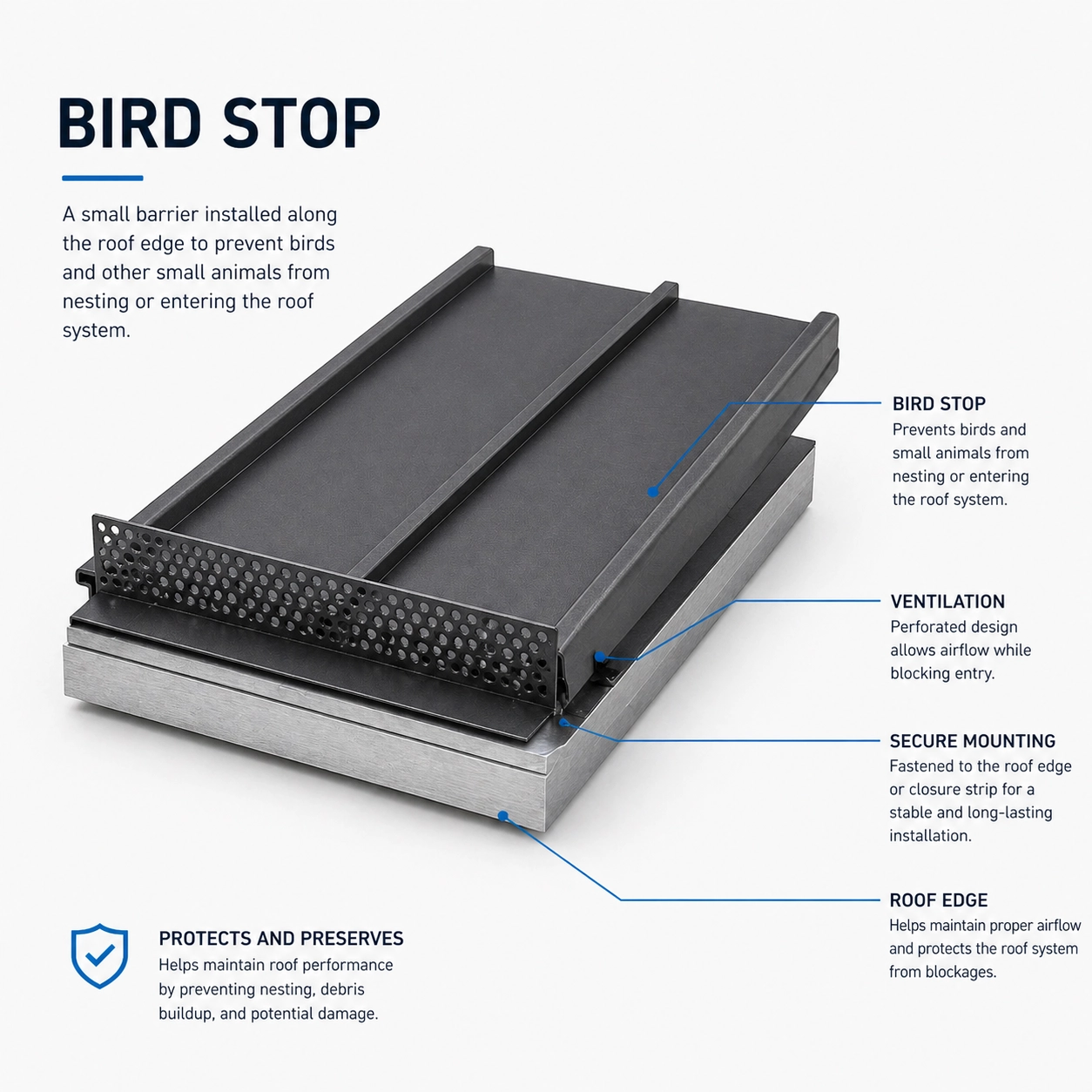
How Bird Stops Enhance Roof Protection, Pest Prevention, and System Longevity
Bird stop is a specialized roofing accessory designed to prevent birds and small animals from entering the gaps between roof tiles or panels and the eaves or ridge. Structurally, a bird stop is typically a shaped metal or plastic strip installed along the lower edge (eaves) or upper edge (ridge) of a pitched roof, conforming to the profile of the roofing material. Its geometry is engineered to fill the voids created by the undulating surfaces of tile, metal, or profiled roofing systems, ensuring a continuous barrier without impeding necessary ventilation.
Functionally, bird stops serve to block access points that could otherwise allow birds, rodents, or debris to enter the roof space, which can compromise insulation, cause water ingress, or lead to structural deterioration. By maintaining the integrity of the roof’s perimeter, bird stops also help preserve water drainage paths and support the roof’s wind resistance by minimizing uplift at vulnerable edges. Bird stops are commonly used in tile and metal roofing systems with pronounced profiles, especially on roofs with moderate to steep slopes where gaps at the eaves or ridge are more pronounced due to roof pitch and tile geometry. Their application is essential in regions where pest intrusion or debris accumulation poses a risk to roof performance and longevity.
How Bird Stop Is Evaluated in Roofing Systems
Bird stop for roof systems is evaluated based on its effectiveness in preventing pest entry, its integration with tile profiles, and its durability under real-world conditions. Roofing professionals assess bird stop placement at the eaves and perimeter edges, ensuring it forms a continuous barrier without gaps that could allow birds, rodents, or debris to enter beneath clay or concrete tiles. Proper bird stop installation on tile roofs is verified by checking for secure fastening, alignment with the tile edge, and compatibility with the specific tile shape and roof pitch.
The function of a bird stop in roof systems is further evaluated by its ability to support water management, allowing for adequate drainage while blocking unwanted intrusion. Professionals compare bird stop vs eave closure options to determine the most suitable solution for the roof type and local pest pressures. During inspections, the lifespan and durability of bird stops are assessed by looking for signs of corrosion, UV degradation, or displacement, which could compromise their performance. Addressing bird stop problems and solutions is critical for maintaining roof integrity and preventing costly repairs due to pest damage or water infiltration.
Overview & Key Considerations
What Is Bird stop
Why Bird stop Matters
Benefits of Bird stop
PEST INTRUSION PREVENTION
Blocks birds and small animals from entering under roof tiles, reducing risk of nesting and associated roof damage.
MOISTURE BARRIER ENHANCEMENT
Helps prevent wind-driven rain and debris from infiltrating beneath tiles, supporting overall roof weather resistance.
SYSTEM INTEGRATION
Ensures a continuous barrier at eaves, maintaining the integrity of the tile roofing system and preventing component displacement.
VENTILATION PRESERVATION
Allows for necessary airflow beneath tiles while restricting animal access, supporting attic ventilation and reducing condensation risk.
Limitations of Bird stop
GAP SUSCEPTIBILITY
Improperly sized or installed bird stops can leave gaps that allow small pests or wind-driven debris to enter the roof assembly.
MOISTURE TRAPPING
Bird stops can inadvertently trap moisture at the eave edge, increasing the risk of corrosion or rot in adjacent roof components.
MATERIAL COMPATIBILITY
Bird stops made from incompatible metals or materials may accelerate galvanic corrosion or degrade adjacent roofing elements.
DEPENDENCY ON EAVE DESIGN
Effectiveness of bird stops is highly dependent on the specific eave detail and tile profile, limiting universal application.
Common Bird stop Problems
GAP FORMATION
Improperly fitted bird stops can create gaps that allow wind-driven rain and debris to penetrate beneath roof tiles.
CORROSION AT INTERFACE
Metal bird stops in contact with dissimilar roofing materials may corrode, leading to premature component failure and water ingress.
PEST INTRUSION
Damaged or missing bird stops enable birds and rodents to nest under tiles, causing insulation disturbance and secondary moisture issues.
WATER DAMMING
Incorrectly installed bird stops can obstruct drainage channels, resulting in localized ponding and accelerated underlayment deterioration.
Bird stop Quick Facts
Use Cases for Bird stop
TILE EDGE PEST BLOCK
Bird stops are installed at the lower edge of tile roofs to prevent birds and rodents from nesting beneath the tiles.
DEBRIS ENTRY PREVENTION
Bird stops help block leaves and debris from accumulating under roof tiles, reducing the risk of moisture buildup and decay.
WIND UPLIFT PROTECTION
Bird stops provide additional resistance against wind-driven rain and uplift at the eaves of tile roofing systems.
AESTHETIC FINISH
Bird stops create a clean, finished appearance at the roof edge by concealing gaps between the tiles and fascia.