
What Is Roof Bridging Installation Method? Installation Process and Applications
TL;DR Bridging Summary
Bridging is an installation method where short pieces of wood or metal are installed between structural members, such as joists or rafters, to provide lateral support and maintain spacing. This technique matters because it helps prevent twisting or movement during roof installation, which can compromise structural integrity. Improper or missing bridging can lead to uneven roof surfaces, increased deflection, and long-term performance issues.
How Roof Bridging Installation Method Enhances Structural Stability and Wind Resistance
Bridging in roofing refers to the installation of diagonal or cross-bracing members between adjacent structural elements, such as rafters or trusses, to enhance lateral stability and load distribution. These bridging components, typically made from wood or metal, are positioned between parallel framing members to prevent twisting, buckling, or lateral displacement under load. The geometry of bridging often involves straight or angled pieces that connect the lower chords or webs of roof trusses, or the sides of rafters, creating a more rigid and unified roof structure.
Functionally, bridging improves the structural efficiency of the roof by distributing live and dead loads more evenly across the framing system. This reinforcement helps maintain consistent roof pitch and slope alignment, reducing the risk of deformation at the ridge, eaves, or intermediate spans. Bridging is especially important in roofs with long spans, steep slopes, or high wind and snow loads, where lateral forces can compromise stability. By enhancing resistance to wind uplift and minimizing deflection, bridging contributes to the overall durability and performance of the roofing system in both residential and commercial applications.
How Roof Bridging Installation Method Quality Is Evaluated During Installation
Evaluating the quality of the roof bridging installation method during construction involves careful assessment of workmanship, adherence to manufacturer specifications, and alignment with project design requirements. Roofing professionals inspect the placement and secure fastening of bridging members, ensuring they are properly spaced and aligned to provide the intended lateral support between structural elements. The roof bridging installation process is checked for correct sequencing, with attention to whether bridging is installed before or after roof decking, as specified by the system design and applicable codes.
Quality assessment also considers the compatibility of bridging with the chosen roofing material, such as roof bridging for metal roofs, where precise alignment and secure attachment are critical to prevent movement or deformation under load. Inspectors look for common roof bridging problems, such as loose connections, misalignment, or inadequate fastening, which can compromise performance, especially in high wind areas. The evaluation process may include verifying that bridging meets structural requirements and does not interfere with other roof components or systems. Ultimately, a high-quality roof bridging installation method enhances structural stability, improves load distribution, and supports long-term roof performance, making thorough evaluation essential for both safety and durability.
Overview & Key Considerations
What Is Bridging
Why Bridging Matters
Benefits of Bridging
INSTALLATION ACCURACY
Bridging ensures consistent alignment of framing members, reducing uneven surfaces and improving substrate support for roofing materials.
LOAD DISTRIBUTION
Proper bridging enhances structural stability by distributing live and dead loads evenly across the roof framing system.
REDUCED INSTALLATION RISK
Using bridging minimizes the risk of joist or rafter twisting during installation, preventing future structural deformation.
LONG-TERM RELIABILITY
Effective bridging increases the long-term reliability of the roof assembly by maintaining framing integrity under thermal and mechanical stresses.
Limitations of Bridging
PRECISION REQUIRED
Bridging demands exact alignment and spacing, making it highly sensitive to installer skill and measurement accuracy.
LOAD TRANSFER RISK
Incorrect bridging installation can create unintended load paths, potentially compromising structural integrity or causing localized deflection.
FASTENER PLACEMENT COMPLEXITY
Bridging often requires precise fastener placement, increasing the risk of missed or improperly anchored connections during installation.
RETROFIT CHALLENGES
Adding bridging to existing structures is labor-intensive and may be restricted by limited access or existing obstructions.
Common Bridging Problems
GAP FORMATION
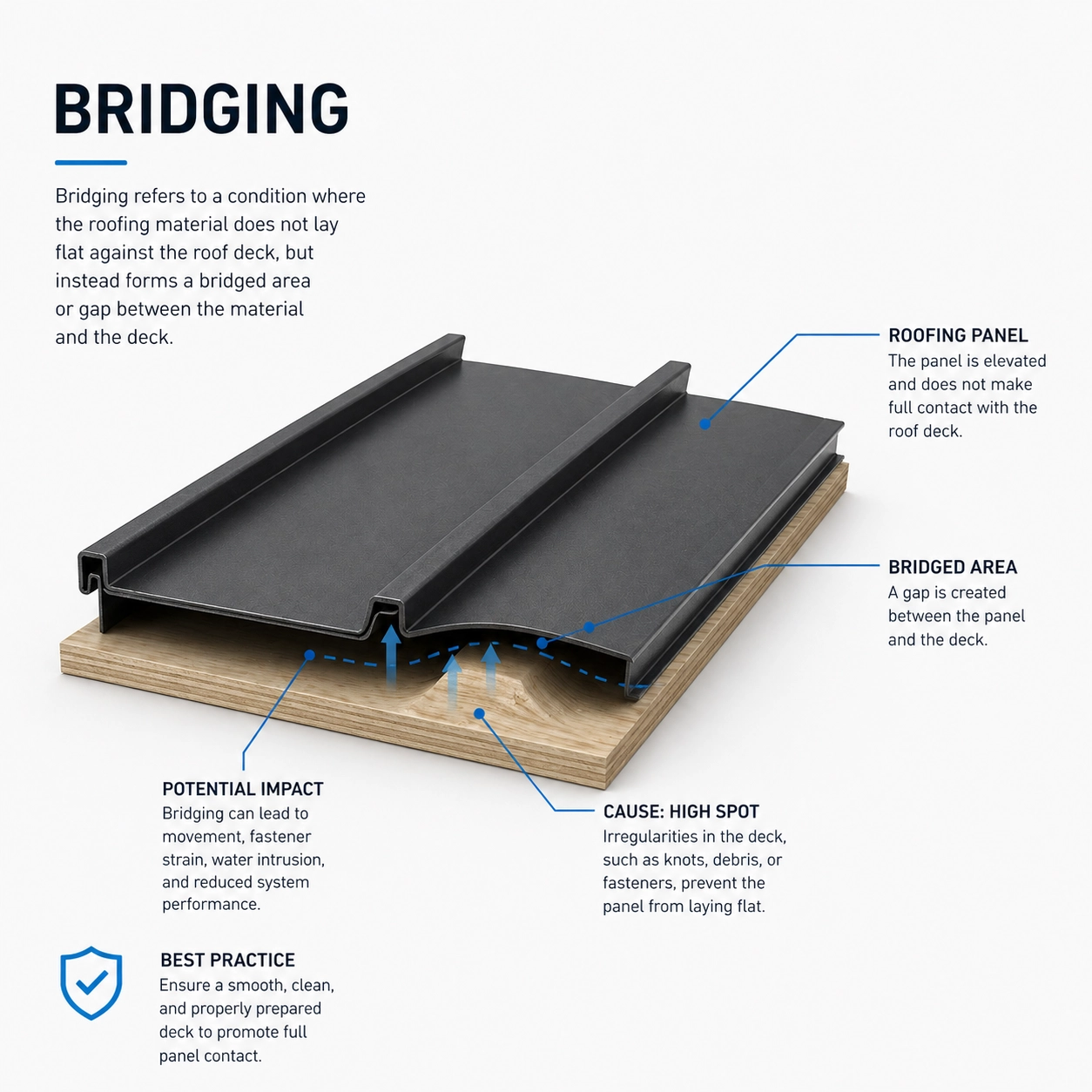
Improper bridging installation can create gaps between structural members, leading to uneven load distribution and localized deck deflection.
LOOSE CONNECTIONS
Incorrect fastening of bridging elements may result in movement under load, causing squeaking floors or compromised structural stability.
MISALIGNED BRIDGING
Failure to align bridging properly during installation can interfere with mechanical penetrations or reduce the effectiveness of lateral bracing.
CORROSION AT CONTACT POINTS
Inadequate protection at bridging connections can allow moisture ingress, accelerating corrosion and weakening the structural assembly over time.
Bridging Quick Facts
Use Cases for Bridging
JOIST ALIGNMENT
Bridging is used during installation to keep roof joists properly spaced and aligned, preventing twisting under load.
STRUCTURAL STIFFENING
Bridging is installed in new construction to increase the lateral stability of roof framing, especially in long-span applications.
RETROFIT REINFORCEMENT
Bridging is added during reroofing to strengthen existing framing where joist movement or deflection has been observed.
SLOPED ROOF SUPPORT
Bridging is preferred on steep-slope roofs to maintain consistent joist spacing and support uniform roof deck installation.