
What Is Roof Buckling? Causes, Signs, and Roofing Impact
TL;DR Buckling Summary
Buckling is a structural defect where roofing materials or components deform, warp, or bend out of plane due to compressive stresses, moisture changes, or installation errors. This matters because buckling can compromise the roof’s weather resistance, appearance, and long-term durability, often leading to leaks or accelerated material failure. Prompt identification and repair are critical to prevent further damage and costly structural issues.
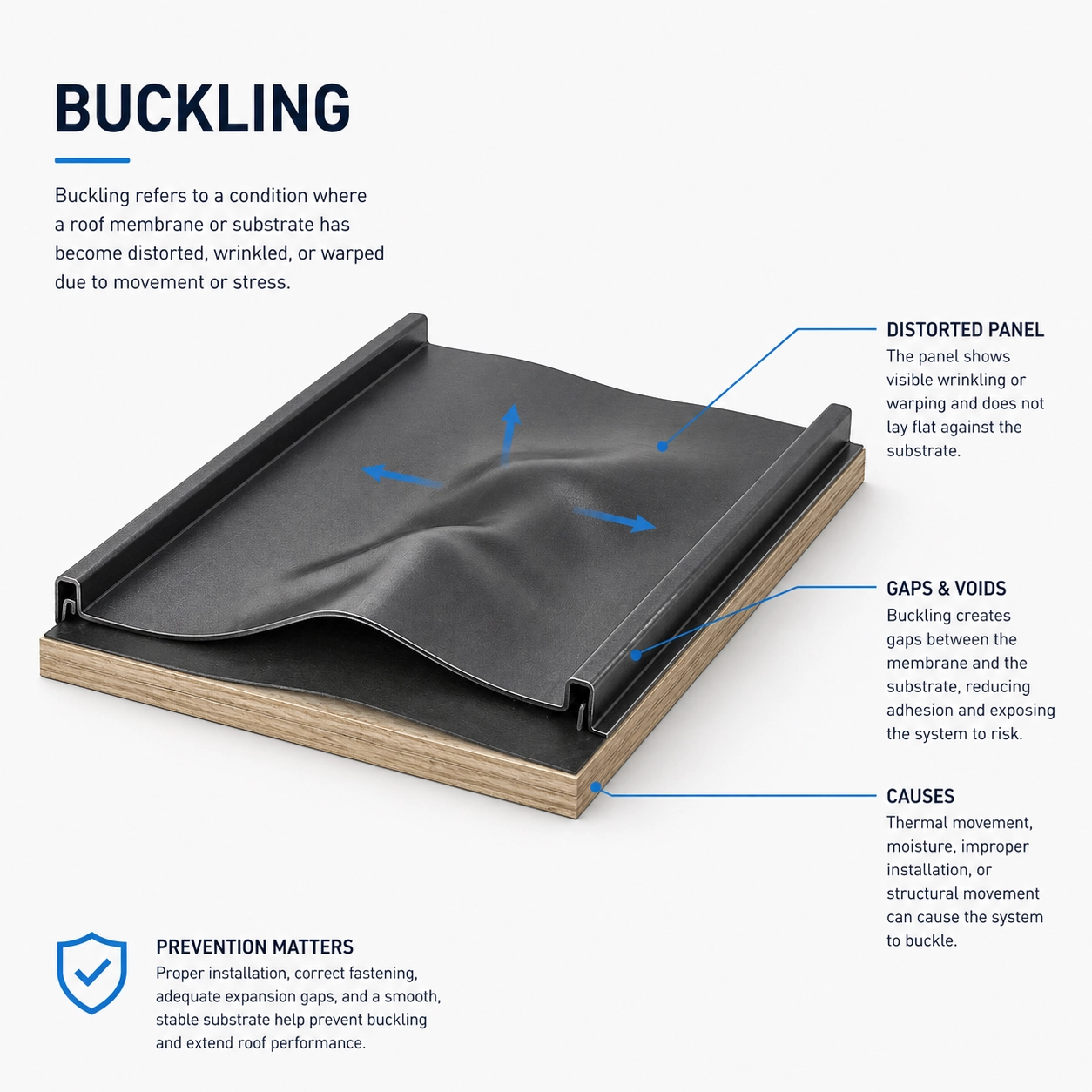
How Roof Buckling Compromises Material Lifespan, Weather Protection, and Structural Integrity
Buckling is a structural deformation that occurs when a roofing component, such as a roof deck, sheathing, or shingle, bends or warps out of its intended plane due to compressive stresses. In roofing systems, buckling typically manifests as visible waves, ridges, or distortions along the roof surface, often running parallel to the roof pitch or between the ridge and eaves. This phenomenon is most commonly associated with materials like plywood, oriented strand board (OSB), or asphalt shingles, especially when subjected to excessive moisture, thermal expansion, or improper installation.
The function of a roof relies on maintaining a stable, planar surface to ensure effective water drainage, snow shedding, and wind resistance. Buckling disrupts this geometry, potentially impeding water flow along slopes and increasing the risk of leaks or premature material failure. It can also compromise the structural efficiency of the roof assembly, as uneven surfaces may reduce the load-bearing capacity and affect the performance of underlayment and fasteners.
Buckling is often observed in climates with significant temperature or humidity fluctuations, or where roof ventilation is inadequate. It is a critical concern in both low-slope and steep-slope roofing, particularly near the ridge, valleys, or areas with insufficient spacing between sheathing panels. Proper material acclimatization, installation techniques, and attention to roof geometry are essential to prevent buckling and maintain long-term roof integrity.
How Roof Buckling Is Identified and Evaluated on a Roof
Roof buckling is identified through a combination of visual inspection and professional assessment, focusing on irregularities such as raised, wavy, or rippled areas in the roof surface, particularly in asphalt shingles or underlayment. Roofing professionals look for signs of buckling in roofing materials, including misaligned shingle courses, uneven roof planes, and areas where shingles appear to lift or distort. These symptoms are often most visible after significant weather changes or following improper installation, and distinguishing roof buckling vs roof warping is critical—buckling typically presents as localized, linear distortions, while warping affects larger areas or structural elements.
Evaluating roof buckling involves determining what causes roof buckling, such as moisture trapped beneath roofing layers, inadequate attic ventilation, improper fastening, or the use of wet or poorly stored materials. Professionals assess the severity by examining the extent of the affected area, the age and condition of the roofing system, and any underlying structural issues. They may also check for related problems, such as compromised underlayment or sheathing, which can impact the roof’s lifespan and performance.
Accurate diagnosis is essential for recommending appropriate solutions, such as how to fix buckling shingles or whether more extensive roof buckling repair is needed. Early identification and evaluation help prevent further damage, reduce repair costs, and extend the service life of the roof. In cases of significant or persistent buckling, a thorough inspection by a qualified roofing contractor is recommended to verify the cause, assess risk, and provide roof buckling prevention tips tailored to the specific roof system.
Overview & Key Considerations
What Is Buckling
Why Buckling Matters
Benefits of Buckling
EARLY ISSUE IDENTIFICATION
Recognizing buckling enables prompt intervention before significant membrane displacement or shingle deformation compromises roof performance.
PREVENTS MOISTURE INTRUSION
Understanding buckling helps prevent water infiltration by addressing gaps or raised seams that can allow leaks.
INFORMS REPAIR STRATEGY
Awareness of buckling guides targeted repair planning, minimizing unnecessary work and focusing on root causes.
REDUCES STRUCTURAL RISK
Detecting buckling early reduces the likelihood of substrate damage or accelerated deterioration of roofing assemblies.
Limitations of Buckling
HIDDEN EARLY STAGES
Buckling often develops beneath surface layers, making early detection difficult until visible deformation or damage occurs.
REPAIR DISRUPTION
Correcting buckling typically requires removal and replacement of affected materials, increasing labor intensity and project disruption.
ESCALATION RISK
If ignored, buckling can rapidly compromise structural integrity, leading to leaks, insulation failure, or widespread roof system damage.
CAUSE IDENTIFICATION CHALLENGE
Multiple underlying factors—such as moisture intrusion, thermal movement, or substrate issues—complicate accurate diagnosis and targeted remediation.
Common Buckling Problems
MEMBRANE TEARING
Buckling creates stress concentrations that can lead to membrane tearing, exposing the roof assembly to water intrusion.
FLASHING SEPARATION
Buckling at flashing interfaces can break adhesion, allowing water to penetrate and cause concealed substrate damage.
FASTENER BACKOUT
Buckling exerts upward force on fasteners, causing them to loosen or back out, compromising wind uplift resistance.
TRAPPED MOISTURE
Buckling forms voids that trap moisture, accelerating insulation deterioration and promoting hidden mold growth within the roof system.
Buckling Quick Facts
Use Cases for Buckling
ROOF INSPECTION FINDINGS
Buckling is commonly identified during roof inspections as visible warping or distortion of shingles, membranes, or panels.
MOISTURE INTRUSION DIAGNOSIS
Buckling often signals underlying moisture problems, prompting further investigation into trapped water or inadequate ventilation.
PREVENTING STRUCTURAL DAMAGE
Early detection of buckling helps prevent more severe structural issues by addressing substrate movement or fastening failures.
REPAIR STRATEGY PLANNING
Buckling informs repair planning by indicating the need for substrate correction, material replacement, or improved installation practices.