
What Is a Mansard Roof? Structure, Design, and Performance
TL;DR Mansard roof Summary
A Mansard roof is a four-sided roof type featuring two slopes on each side, with the lower slope steeper than the upper, creating additional usable attic or living space. This design maximizes interior volume and allows for flexible upper-story layouts, especially in urban or space-constrained settings. However, the complex geometry increases construction costs and can present waterproofing and drainage challenges, particularly in regions with heavy rainfall or snow.
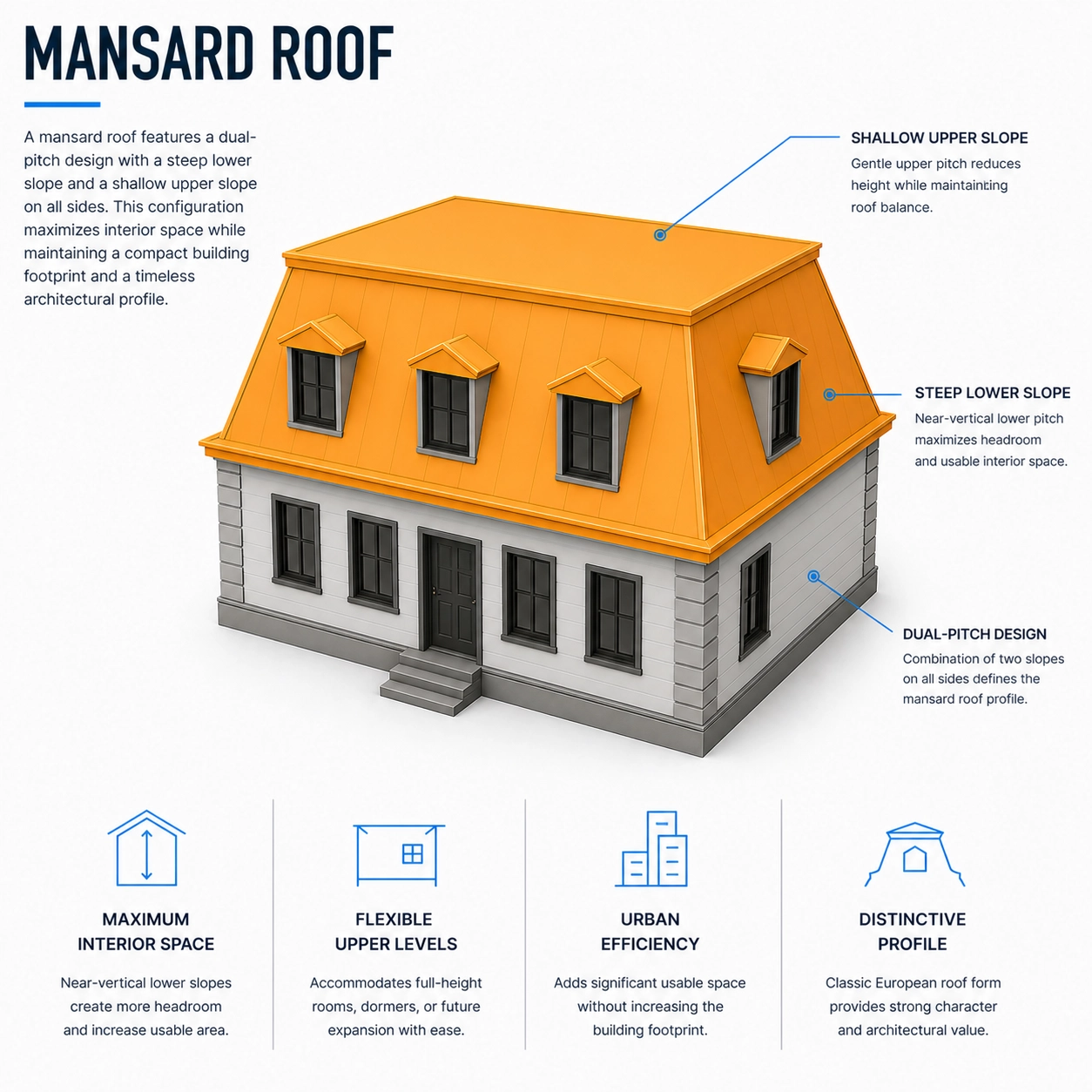
How Mansard Roof Design Influences Drainage, Durability, and Architectural Versatility
A Mansard roof is a four-sided, dual-pitched roof characterized by two distinct slopes on each side, with the lower slope being significantly steeper than the upper. This design creates a nearly vertical lower section and a much flatter upper section, meeting at a pronounced ridge and extending to deep eaves. The geometry of a Mansard roof maximizes the usable attic or upper floor space beneath the roof, often allowing for full-height rooms and dormer windows within the steep lower slopes.
Functionally, the Mansard roof offers structural efficiency by distributing loads evenly across the walls and providing additional interior volume without increasing the building’s overall height. The steep lower slopes facilitate effective water drainage and moderate snow shedding, though the flatter upper pitch may require enhanced waterproofing and regular maintenance to prevent pooling. Wind resistance is generally adequate, but the complex shape can introduce vulnerabilities at the ridge and eaves if not properly detailed.
Mansard roofs are commonly used in urban architecture, particularly in historic French and Second Empire-style buildings, where maximizing interior space within height restrictions is essential. Their distinctive profile and functional attic space make them suitable for multi-story residential and commercial structures seeking both aesthetic distinction and practical upper-level usage.
How Mansard Roof Performance Is Evaluated in Roof Design
Mansard roof performance is evaluated by examining several key design and structural factors that influence its suitability for various architectural and environmental contexts. Roofing professionals assess the steep lower slope and nearly flat upper slope to determine how effectively the mansard roof manages water drainage, especially compared to other roof types such as the gambrel roof. Proper drainage is critical, as the upper flat section can be prone to water pooling if not designed with adequate slope or drainage systems, impacting long-term durability and increasing maintenance needs.
Load handling is another essential aspect, particularly in regions with heavy snowfall. The mansard roof’s structure must be engineered to support snow accumulation on the upper slope, and its framing is evaluated for compliance with local building codes and snow load requirements. Wind resistance is also assessed, as the multiple slopes and roof edges can create uplift pressures; professionals verify that materials, fastenings, and detailing meet or exceed standards for wind performance.
Architectural suitability and cost factors are considered during evaluation, as the mansard roof offers unique advantages—such as maximizing usable attic space and enabling distinctive façade treatments—but may involve higher construction costs due to complex framing and detailing. Roofing experts weigh these advantages and disadvantages, along with climate-specific risks, to determine if a mansard roof is the optimal choice for a given project. Ultimately, the evaluation process integrates drainage performance, structural integrity, climate adaptability, and architectural intent to ensure the mansard roof delivers both functional and aesthetic value.
Overview & Key Considerations
What Is Mansard roof
Why Mansard roof Matters
Benefits of Mansard roof
MAXIMIZED USABLE SPACE
The steep lower slopes and flat upper deck of a mansard roof create additional full-height attic or living space.
MULTIPLE ROOF PLANES
Distinct double-pitched geometry allows for complex architectural detailing and flexible window or dormer placement.
IMPROVED WATER DRAINAGE
The steep lower slopes efficiently shed rain and snow, reducing the risk of water accumulation at the eaves.
ENHANCED WIND PERFORMANCE
The angled design and multiple planes help deflect wind loads, improving structural stability in high-wind conditions.
Limitations of Mansard roof
COMPLEX FRAMING REQUIREMENTS
Mansard roofs demand intricate structural framing to support dual slopes and extended eaves, increasing engineering and construction complexity.
DRAINAGE CHALLENGES
The nearly flat upper slope of a mansard roof is prone to water pooling and requires precise drainage design to prevent leaks.
SNOW LOAD VULNERABILITY
Low-pitch upper sections of mansard roofs are susceptible to excessive snow accumulation, increasing structural load risks in cold climates.
WIND UPLIFT RISK
The steep lower slopes and extended overhangs of mansard roofs can create uplift zones, heightening vulnerability to wind damage.
Common Mansard roof Problems
DRAINAGE CONCENTRATION
The steep lower slope of a mansard roof can cause water to accumulate at the eaves, increasing leak risk.
WIND UPLIFT VULNERABILITY
The abrupt roof angle transition creates turbulence, making mansard roofs more susceptible to wind uplift and shingle loss.
SNOW LOAD ACCUMULATION
The flat or shallow upper section of a mansard roof can trap snow, leading to excessive structural loading and potential collapse.
FLASHING FAILURE POINTS
Complex geometry at the roof-wall junctions increases the likelihood of flashing failures and subsequent moisture intrusion.
Mansard roof Quick Facts
Use Cases for Mansard roof
URBAN INFILL MAXIMIZATION
Mansard roofs are ideal for maximizing usable attic or loft space in urban infill projects with strict height restrictions.
FRENCH-INSPIRED ARCHITECTURE
Mansard roofs are commonly specified for historic restorations or new builds emulating Second Empire or French Renaissance architectural styles.
SNOW SHEDDING LIMITATIONS
Mansard roofs are less suitable for regions with heavy snowfall, as the low-slope upper section can accumulate snow and require additional structural support.
MULTI-STORY BUILDING DESIGN
Mansard roofs are often chosen for multi-story residential or commercial buildings to create a full upper floor without exceeding zoning height limits.