
What Is a Dormer Roof? Structure, Design, and Performance
TL;DR Dormer roof Summary
A Dormer roof is a structural extension that projects vertically from a sloped main roof, creating additional headroom and usable space beneath. Because it introduces vertical surfaces and roof-wall intersections, a dormer roof affects drainage patterns and increases the complexity of weatherproofing. Proper design and flashing are critical, as dormers are prone to leaks and require careful integration to prevent water intrusion.
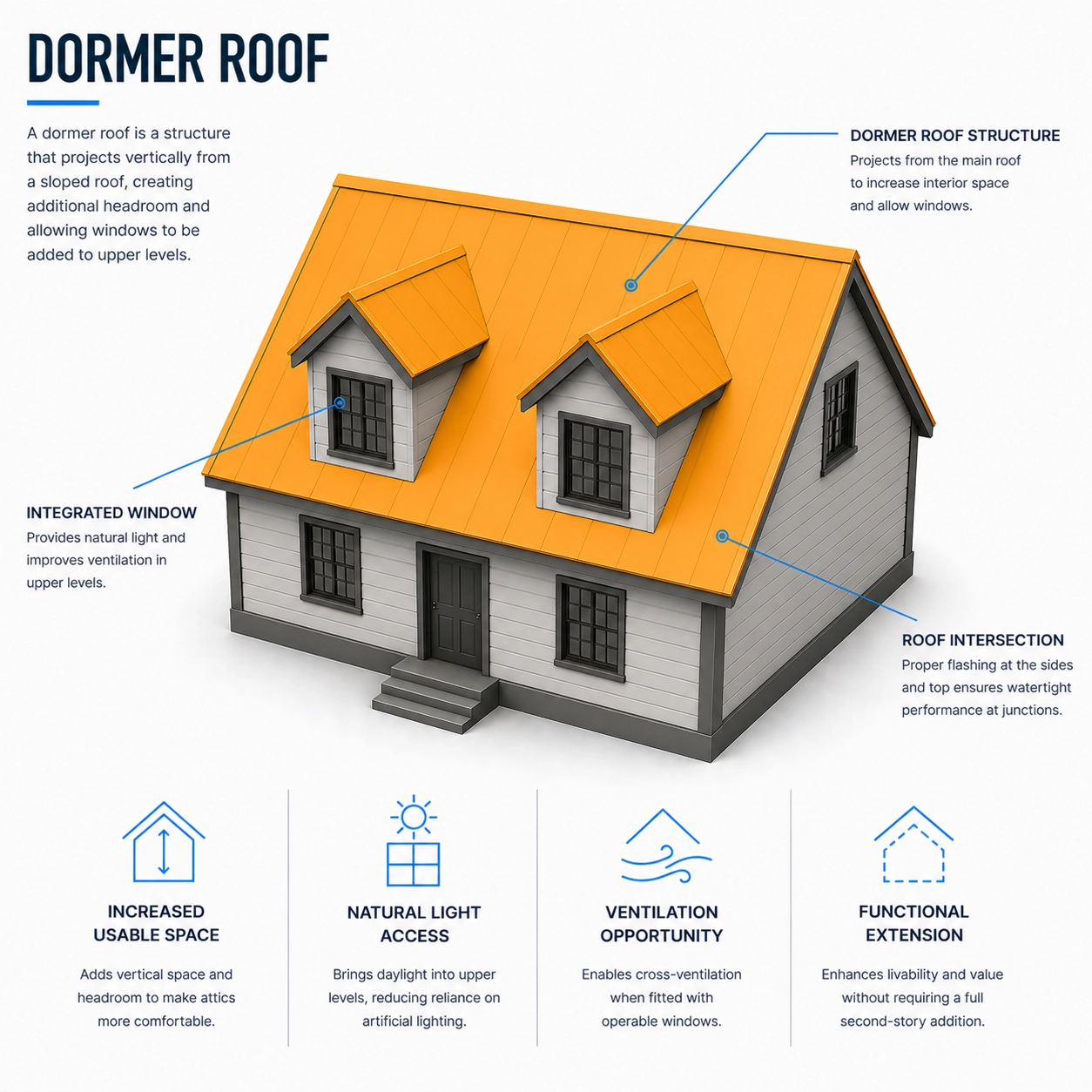
How Dormer Roofs Enhance Attic Space, Natural Light, and Roof Performance
Dormer roof refers to a secondary roof structure that projects vertically from the plane of a sloped main roof, typically housing a window and creating additional headroom and usable space within the roof area. The dormer itself consists of its own roof—often gabled, hipped, shed, or flat—integrated into the main roof’s geometry, intersecting at the ridge, slopes, or eaves. The framing of a dormer roof requires precise integration with the primary roof system to maintain structural integrity and weather resistance.
Functionally, a dormer roof enhances natural light and ventilation in attic or upper-story spaces while increasing the functional floor area beneath steep roof pitches. Properly designed dormers facilitate effective water drainage by directing runoff away from window openings and critical joints, reducing the risk of leaks. The roof pitch and slope of both the dormer and main roof must be coordinated to ensure efficient snow shedding and to minimize wind uplift forces at the intersection points.
Dormer roofs are commonly used in residential construction, especially in homes with steeply pitched roofs or limited upper-story space. They are essential in maximizing usable interior volume without altering the overall building footprint, making them a practical solution in both new builds and roof retrofits.
How Dormer Roof Performance Is Evaluated in Roof Design
Dormer roof performance is evaluated in roof design by assessing several key factors that influence both function and durability. Professionals consider the slope and integration of the dormer roof with the main roof structure, ensuring proper drainage and minimizing the risk of water intrusion at critical junctions. The ability of a dormer roof to handle snow loads, especially in regions with heavy snowfall, is a primary concern; inadequate design or insufficient slope can lead to snow accumulation, ice damming, and potential structural stress. Ventilation and insulation are also evaluated, as dormer roofs often serve to expand attic space and improve natural light, but can introduce thermal bridging or moisture issues if not properly detailed.
Architectural suitability and compatibility with the overall roof type are important in the evaluation process. Roofing professionals compare dormer roof vs gable roof configurations to determine which best meets the project’s functional and aesthetic goals, taking into account the dormer roof advantages such as increased usable space and daylight. Potential dormer roof problems, such as flashing failures or improper integration with existing roofing materials, are identified during design reviews and site inspections. Cost considerations, including the complexity of framing and waterproofing, are factored into the overall assessment to ensure the dormer roof delivers long-term performance and value.
Overview & Key Considerations
What Is Dormer roof
Why Dormer roof Matters
Benefits of Dormer roof
INCREASED USABLE SPACE
Dormer roofs create additional headroom and functional floor area within attic or upper-story spaces.
IMPROVED NATURAL LIGHT
The vertical walls of dormer roofs allow for window installation, enhancing daylight penetration into interior rooms.
ENHANCED ROOF DRAINAGE
Dormer roof geometry introduces additional slopes and valleys, promoting efficient water runoff and reducing pooling risks.
AESTHETIC ARCHITECTURAL VARIETY
Dormer roofs add visual interest and complexity to rooflines, contributing to distinctive architectural character and curb appeal.
Limitations of Dormer roof
COMPLEX STRUCTURAL INTEGRATION
Dormer roofs require precise integration with the main roof structure, increasing framing complexity and risk of structural discontinuities.
DRAINAGE INTERFERENCE
Dormer roof geometry often disrupts primary roof drainage paths, increasing vulnerability to localized water accumulation and leakage.
THERMAL BRIDGING RISK
Intersecting planes and framing in dormer roofs create additional thermal bridges, complicating insulation continuity and energy efficiency.
SNOW LOAD ACCUMULATION
Dormer valleys and step transitions can trap snow, concentrating loads and increasing risk of localized structural stress in cold climates.
Common Dormer roof Problems
POOR DORMER DRAINAGE
Dormer roof geometry often creates dead valleys, leading to water ponding and increased risk of localized leakage.
SNOW ACCUMULATION STRESS
Dormer roofs can trap snow against vertical walls, causing excessive snow load and potential structural deformation or collapse.
WIND UPLIFT AT JUNCTIONS
Complex dormer intersections are prone to wind uplift at flashing and seam locations, increasing the risk of membrane failure.
ICE DAM FORMATION
Dormer roof transitions frequently experience ice damming, resulting in water backup and interior moisture intrusion.
Dormer roof Quick Facts
Use Cases for Dormer roof
ADDITIONAL ATTIC SPACE
Dormer roofs are ideal for creating usable attic or loft space in homes with steeply pitched main roofs.
NATURAL LIGHT INCREASE
Dormer roofs are commonly used to introduce daylight and ventilation into upper-story rooms or converted attic spaces.
HISTORIC STYLE MATCH
Dormer roofs are frequently specified to maintain architectural authenticity in Colonial, Victorian, or Craftsman-style buildings.
RAINWATER DRAINAGE IMPROVEMENT
Dormer roofs are selected to improve water runoff and prevent pooling on complex roof structures with intersecting slopes.