
What Is a Jerkinhead Roof? Structure, Design, and Performance
TL;DR Jerkinhead roof Summary
A Jerkinhead roof is a hybrid roof type where the gable ends are clipped or hipped, creating a truncated, sloped appearance at the peak. This design improves wind resistance and drainage compared to standard gable roofs, reducing vulnerability to uplift and water intrusion. However, its complex geometry can increase framing costs and may require specialized installation expertise for optimal weather performance.
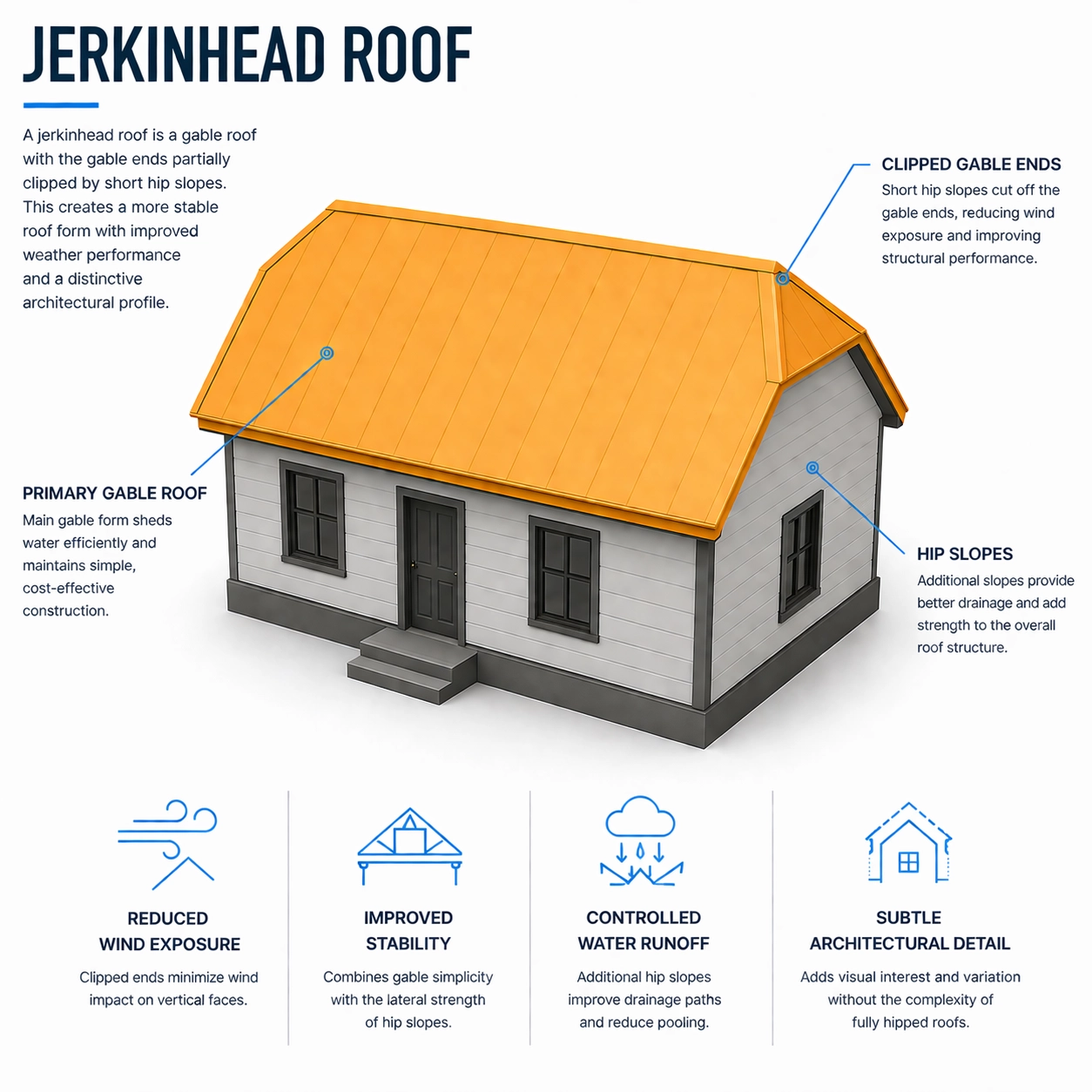
How Jerkinhead Roof Design Enhances Wind Resistance and Drainage Performance
A Jerkinhead roof, also known as a clipped gable or half-hip roof, is a hybrid roof structure that combines elements of both gable and hip roofs. Its defining feature is the truncation or clipping of the gable peak, where the upper portion of the gable end is replaced by a short, sloped hip. This creates a roof with two main slopes meeting at a ridge, while the gable ends are partially hipped, resulting in a distinctive, compact profile.
Structurally, the Jerkinhead roof offers enhanced wind resistance compared to traditional gable roofs, as the clipped ends reduce wind uplift forces on the ridge and eaves. The design also promotes efficient water drainage and snow shedding due to its moderate to steep roof pitch and multiple slopes. While the clipped gable reduces some usable attic space compared to a full gable, it maintains more interior volume than a full hip roof.
Jerkinhead roofs are commonly used in regions prone to high winds or heavy precipitation, as their geometry improves structural stability and weather performance. They are found in various architectural styles, particularly in Craftsman and Tudor designs, where both function and distinctive appearance are desired.
How Jerkinhead Roof Performance Is Evaluated in Roof Design
Jerkinhead roof performance is evaluated by examining how its unique design features—specifically the clipped or hipped gable ends—impact structural integrity, weather resistance, and suitability for various climates. Roofing professionals assess the jerkinhead roof by analyzing its slope and truncated gable ends, which are engineered to reduce wind uplift compared to traditional gable roofs. This design offers notable advantages in wind resistance, making it a preferred choice in regions prone to high winds. Evaluators also consider the roof’s ability to handle snow loads, as the partial hip structure can help shed snow more efficiently than a standard gable, improving performance in snowy climates.
Drainage performance is another critical factor, with the jerkinhead roof’s configuration promoting effective water runoff and minimizing the risk of water pooling at the eaves or valleys. Professionals review the roof’s framing and load distribution to ensure it meets local building codes and structural requirements, especially where heavy precipitation or snow is common. Additionally, the jerkinhead roof is assessed for its architectural compatibility and common uses, such as in residential and historic buildings where both aesthetic appeal and functional performance are desired. Overall, the evaluation process balances structural analysis, climate suitability, and drainage efficiency to determine the optimal application and long-term reliability of the jerkinhead roof style.
Overview & Key Considerations
What Is Jerkinhead roof
Why Jerkinhead roof Matters
Benefits of Jerkinhead roof
IMPROVED WIND RESISTANCE
The clipped gable design of a jerkinhead roof reduces wind uplift forces on gable ends, enhancing storm performance.
OPTIMIZED DRAINAGE
The combination of hip and gable slopes promotes efficient water runoff, minimizing pooling and potential water intrusion.
INCREASED ATTIC USABLE SPACE
Jerkinhead roofs provide more usable attic volume than full hip roofs due to their partial gable ends.
ENHANCED STRUCTURAL STABILITY
The shortened gable peaks distribute roof loads more evenly, reducing stress concentrations at ridge and eave intersections.
Limitations of Jerkinhead roof
COMPLEX FRAMING REQUIREMENTS
Jerkinhead roofs require intricate hip and gable intersections, increasing structural complexity and demanding precise carpentry for stability.
REDUCED ATTIC USABILITY
The clipped gable design of a jerkinhead roof limits usable attic space compared to full gable or hip roofs.
DRAINAGE CHALLENGES
Jerkinhead roofs can create valleys and transition points that complicate water runoff, increasing vulnerability to localized drainage issues.
WIND LOAD SENSITIVITY
The partial gable ends of jerkinhead roofs may concentrate wind forces, requiring careful engineering in high-wind or hurricane-prone regions.
Common Jerkinhead roof Problems
DRAINAGE CONCENTRATION
Jerkinhead roof geometry can cause water to concentrate at hip valleys, increasing risk of localized leaks and overflow.
WIND UPLIFT VULNERABILITY
The truncated gable ends of a jerkinhead roof can create turbulent wind zones, elevating uplift pressures and shingle displacement.
SNOW LOAD ACCUMULATION
Complex intersections on jerkinhead roofs can trap snow, leading to uneven load distribution and potential structural stress.
FRAMING COMPLEXITY STRESS
Irregular framing transitions in jerkinhead roofs may introduce stress points, increasing risk of rafter deflection or joint failure.
Jerkinhead roof Quick Facts
Use Cases for Jerkinhead roof
WIND RESISTANCE DESIGN
Jerkinhead roofs are chosen in hurricane-prone regions for their clipped gable ends, which reduce wind uplift compared to standard gables.
COTTAGE ARCHITECTURE
Historic and modern cottages often use jerkinhead roofs to blend traditional gable aesthetics with improved structural stability.
MAXIMIZING ATTIC SPACE
Jerkinhead roofs are specified when homeowners want increased usable attic or loft space without the full height of a gable.
RAINWATER MANAGEMENT
Buildings in areas with moderate rainfall use jerkinhead roofs for their effective drainage while maintaining a distinctive roofline.