

Clay or Concrete Tile Roof Problems
Quick Answer
Tile roofs face several recurring problems: individual tiles crack, slide out of place, or chip; mortar fails and white efflorescence stains appear; moss takes hold in damp climates; and — most expensively — the underlayment beneath the tiles wears out long before the tiles do, requiring the whole roof to be removed and relaid to replace it. Tile is also heavy enough to need structural reinforcement. An Interlock aluminum Mediterranean Tile delivers the same look at about 96% less weight, with none of those failure modes.
Clay and concrete tile roofs are beautiful and long-lasting, but they crack, slide, and chip, grow moss and stains, and sit on underlayment that fails decades before the tiles — a repair that means removing the entire roof. They're also very heavy. An aluminum Mediterranean Tile gives the look at ~96% less weight.
A tile roof can look stunning for decades — right up until the day a contractor explains that fixing the leak means taking the entire roof off first.
Clay and concrete tile roofs earn their reputation for beauty and longevity; some last 50 to 100 years. But that headline lifespan hides a set of real, recurring problems that catch many homeowners by surprise — from cracked and sliding tiles to a hidden weak link beneath them. Tile is just one entry among the most popular roof types, and it's worth knowing where it falls short before you commit to it.
The good news is that the look homeowners love about tile no longer requires the weight and maintenance that come with it. Interlock's aluminum Mediterranean Tile reproduces the barrel-tile profile while solving tile's biggest weaknesses.
What are the common problems with clay and concrete tile roofs?
Tile roofs face several recurring problems: individual tiles crack, slide out of place, or chip; mortar fails and white efflorescence stains appear; moss takes hold in damp climates; and — most expensively — the underlayment beneath the tiles wears out long before the tiles do, requiring the whole roof to be removed and relaid to replace it. Tile is also heavy enough to need structural reinforcement. An Interlock aluminum Mediterranean Tile delivers the same look at about 96% less weight, with none of those failure modes.
Cracked, Sliding, and Chipped Tiles
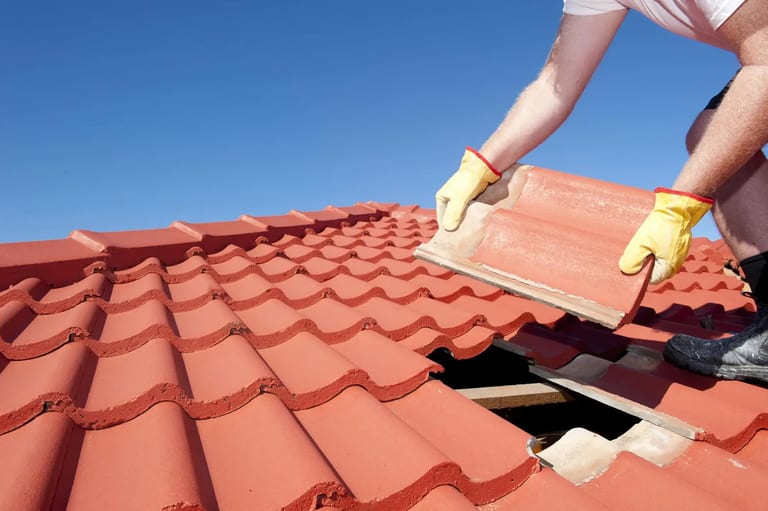
Tile is hard but brittle. Individual tiles crack under foot traffic, falling branches, hail, or simple freeze-thaw stress, and concrete tiles can chip at the edges over time. Tiles can also slide out of position as the fasteners or battens holding them loosen with age, leaving gaps that expose the underlayment to the weather. Each cracked or displaced tile is a potential leak point.
Mortar, Stains, and Moss
The mortar used at ridges, hips, and rakes deteriorates and cracks over the years, loosening tiles and opening paths for water. Concrete tiles are also prone to efflorescence — the chalky white staining that appears as soluble salts migrate to the surface — which dulls the roof's appearance. In damp, shaded, or coastal climates, moss and algae colonize the porous surface and hold moisture against the tiles. Tile isn't alone here — asphalt shingles develop their own set of problems over time, just from different causes.
When the Underlayment Fails
This is tile's most expensive secret. The waterproof underlayment beneath the tiles — not the tiles themselves — is what actually keeps water out, and its lifespan is typically far shorter than the tiles above it. When the underlayment wears out, the only way to replace it is to remove and reinstall every tile on the roof, a labor-intensive and costly project. So a "100-year" tile roof can require a full, expensive intervention at the 20–30 year mark, long before the tiles are spent.
The Weight Problem
Clay and concrete tile are heavy — heavy enough that many homes need additional structural reinforcement to carry them, and many existing homes simply can't take the load without expensive framing upgrades. That weight is dead load your structure carries for the life of the roof.
The Aluminum Alternative: The Look, Without the Weight
Here's where the trade-offs disappear. Interlock's aluminum Mediterranean Tile reproduces the barrel-tile profile homeowners love, but at roughly 70 lbs per 100 square feet — about 96% lighter than concrete tile — so it rarely needs structural reinforcement and can often go over an existing roof. It won't crack, slide, chip, stain, or grow moss the way tile does, and there's no separate underlayment-replacement cliff because the interlocking aluminum panels are the weather barrier. It's one of several metal roofing styles built to solve exactly this kind of material trade-off.
Is Tile the Right Choice?
Tile remains a genuinely beautiful, long-lived material, and for the right home it can be the perfect fit. But its problems — fragility, staining, moss, the underlayment cliff, and sheer weight — are worth understanding before you commit. If it's the Mediterranean look you're after rather than the material itself, an aluminum tile profile delivers it with far fewer headaches.
Frequently Asked Questions
How long do tile roofs last?
Tile roofs can last 50 to 100 years, but the waterproof underlayment beneath them typically fails far sooner — often in 20–30 years — and replacing it requires removing all the tiles.
Why do roof tiles crack?
Tile is hard but brittle, so it cracks under foot traffic, falling debris, hail, and freeze-thaw stress. Concrete tiles also chip at the edges, and tiles can slide as their fasteners loosen with age.
What are the white stains on roof tiles?
That's efflorescence — chalky white staining that appears as soluble salts migrate to the surface of concrete tiles. It dulls the roof's look but is mainly cosmetic.
Are tile roofs too heavy for my home?
Often, yes. Clay and concrete tile are heavy enough that many homes need structural reinforcement to carry them. Interlock's aluminum Mediterranean Tile weighs about 96% less, avoiding that problem.
Can I get the tile look without the problems?
Yes. Interlock's aluminum Mediterranean Tile reproduces the barrel-tile profile at a fraction of the weight, without cracking, sliding, staining, moss, or the underlayment-replacement cliff.
Why does the underlayment matter so much?
The underlayment, not the tile, is the actual waterproof layer. Because it wears out long before the tiles, a tile roof can need a full, costly tile removal and relay decades before the tiles themselves fail.
Explore Interlock Metal Roofing
Last updated June 9, 2026 · Reviewed for accuracy by the Interlock SEO Desk.