

Installing Solar Panels on an Interlock Metal Roof
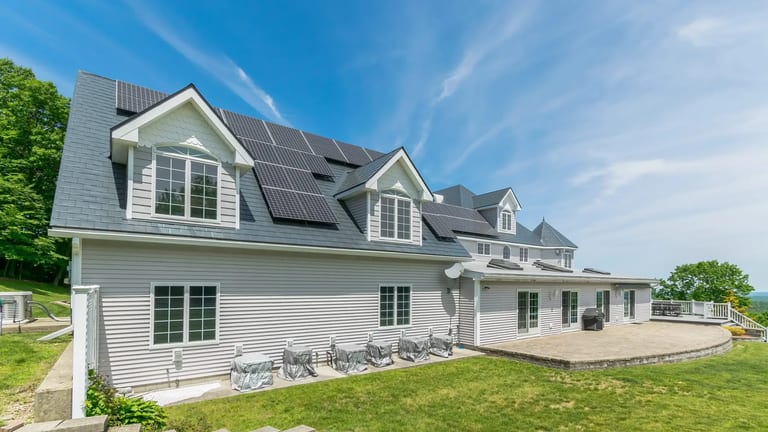
Quick Answer
Yes — Interlock metal roofs are one of the best surfaces for solar panels. The roof lasts 40 to 70 years or more, far longer than the 25–30 year life of a PV array, so you avoid the costly remove-and-reinstall cycle. Standing Seam profiles let panels clamp directly to the seams with no holes drilled in the roof, installing solar does not void the Interlock warranty, and the reflective Alunar® surface keeps the panels cooler, which improves their efficiency.
Mounting solar on an Interlock metal roof comes down to the hardware: on Standing Seam, clamps grip the raised seams with zero penetrations, keeping the roof watertight. Other profiles use mounting systems engineered for metal roofing. The lightweight aluminum panels (~0.41 psf) leave structural headroom for the array, and installing solar does not void the roof's warranty when done properly.
Most solar guides talk about panels and inverters. Fewer talk about the one detail that determines whether the install goes cleanly: how the array actually attaches to the roof underneath it.
On a metal roof, that answer varies by profile — and getting it right is what keeps the roof watertight and the warranty intact. Here's the mounting and structural detail for putting solar on an Interlock system.
How do solar panels mount to an Interlock metal roof?
On Interlock Standing Seam, mounting clamps grip the raised seams directly, securing the array with no holes drilled through the roofing at all. On Interlock's other profiles — Slate, Cedar Shingle, Shake, and Mediterranean Tile — panels attach using mounting hardware engineered specifically for metal roofing, installed by qualified professionals. In both cases, done correctly, solar installation does not void the roof's warranty.
Standing Seam: Clamp-On, Zero Penetrations
Standing Seam is the profile built for solar. Its raised, continuous seams give mounting clamps a mechanical grip point that doesn't require drilling through the panel at all. That matters structurally as much as it matters for leaks: every penetration through a roofing membrane is a potential failure point, and eliminating them entirely removes that risk rather than managing it with sealant.
Mounting on Slate, Shake, and Tile Profiles
Interlock's shingle-style profiles — Slate, Cedar Shingle, Shake, and Mediterranean Tile — use mounting hardware engineered specifically for metal roofing rather than generic asphalt-shingle mounts. Getting this right requires installers who understand both the roofing system and the mounting hardware, which is why solar on these profiles should be installed by professionals familiar with the system, not treated as an afterthought bolted on by a solar-only crew.
That coordination matters in practice, not just in theory. As one Seattle, WA customer noted of their installation: "Brought excellent product examples to illustrate Metal Shingles; coordination and higher costs for special solar-panel stanchions on shingle and slate roofs were a challenge, so plan stanchion details and budgeting up front." Planning the stanchion details and mounting budget before the crew arrives avoids exactly that kind of mid-project friction.
"Brought excellent product examples to illustrate Metal Shingles; coordination and higher costs for special solar-panel stanchions on shingle and slate roofs were a challenge, so plan stanchion details and budgeting up front." — Bill & Susan McKenzie, Seattle, Washington · Installed May 2017 · Verified GuildQuality review
Structural Capacity for the Added Load
A solar array adds weight and wind-load surface area to a roof, and both matter to the structure underneath. Interlock panels themselves are lightweight — roughly 0.41 psf — which leaves more of a roof's total load capacity available for the array compared to heavier roofing materials. That said, any solar installer should still confirm specific rafter and truss capacity for your home before mounting an array of a given size.
It Won't Void Your Warranty
A common and reasonable worry is whether adding solar will void the roof warranty. With Interlock, installing solar panels does not void the roof's warranty when done properly — a major advantage over many roofing systems where third-party penetrations can compromise coverage. Because Standing Seam mounting requires no penetrations at all, there's nothing to breach, and the Guardian Lifetime Limited Warranty stays intact behind your array.
A Cooler Roof Helps Panels Perform
Solar panels lose efficiency as they heat up, and a hot roof bakes the array from below. Interlock's reflective Alunar® finish keeps the roof surface cooler than dark asphalt, which in turn keeps the panels themselves cooler and helps them operate closer to their rated efficiency — a performance benefit that has nothing to do with the mounting hardware itself.
Plan the Mounting Method Before You Plan the Array
If solar is on your horizon, the mounting method should be part of the roofing decision, not an afterthought once the panels arrive. Choosing Standing Seam if solar is a priority, or confirming the right hardware for another profile, means the installation goes cleanly the first time. For the bigger-picture sustainability case for pairing solar with a long-lived roof, see Investing in a Sustainable Future. Request a free quote and tell us your solar plans so we can set the roof up right.
Frequently Asked Questions
How do solar panels attach to an Interlock Standing Seam roof?
Mounting clamps grip the raised seams directly, so the array is secured with zero holes drilled through the roofing — the watertight surface stays completely intact.
How are panels mounted on Interlock's other profiles?
Slate, Cedar Shingle, Shake, and Mediterranean Tile use mounting hardware engineered for metal roofing, installed by qualified professionals familiar with the system.
Will installing solar void my roof warranty?
No. Installing solar panels on an Interlock roof does not void the roof's warranty when done properly, and clamp-on Standing Seam mounting requires no penetrations at all.
Does the roof need extra structural reinforcement to carry solar panels?
Usually not. Interlock panels are lightweight (about 0.41 psf), which leaves more of the roof structure's load capacity available for a solar array compared to heavier roofing materials.
Does a metal roof affect solar panel performance?
Yes, positively. The reflective Alunar® finish keeps the roof surface cooler than dark asphalt, and because PV panels lose efficiency as they heat up, cooler operating temperatures help them produce closer to rated output.
Should solar and roofing be planned together?
Yes. Coordinating the two means the mounting method is chosen alongside the roofing profile, rather than retrofitted onto a roof not designed with solar in mind.
Explore Interlock Metal Roofing
Last updated June 9, 2026