
What Is Architectural Shingles Roofing? Properties, Performance, and Uses
TL;DR Architectural Shingles Summary
Architectural shingles are a type of asphalt roofing material engineered with multiple layers to create a dimensional, slate-like appearance and enhanced durability. Their laminated construction improves weather resistance and lifespan compared to traditional three-tab shingles, making them popular for both residential and commercial applications. Homeowners should consider that while architectural shingles offer superior performance, they typically come at a higher upfront cost than basic asphalt options.
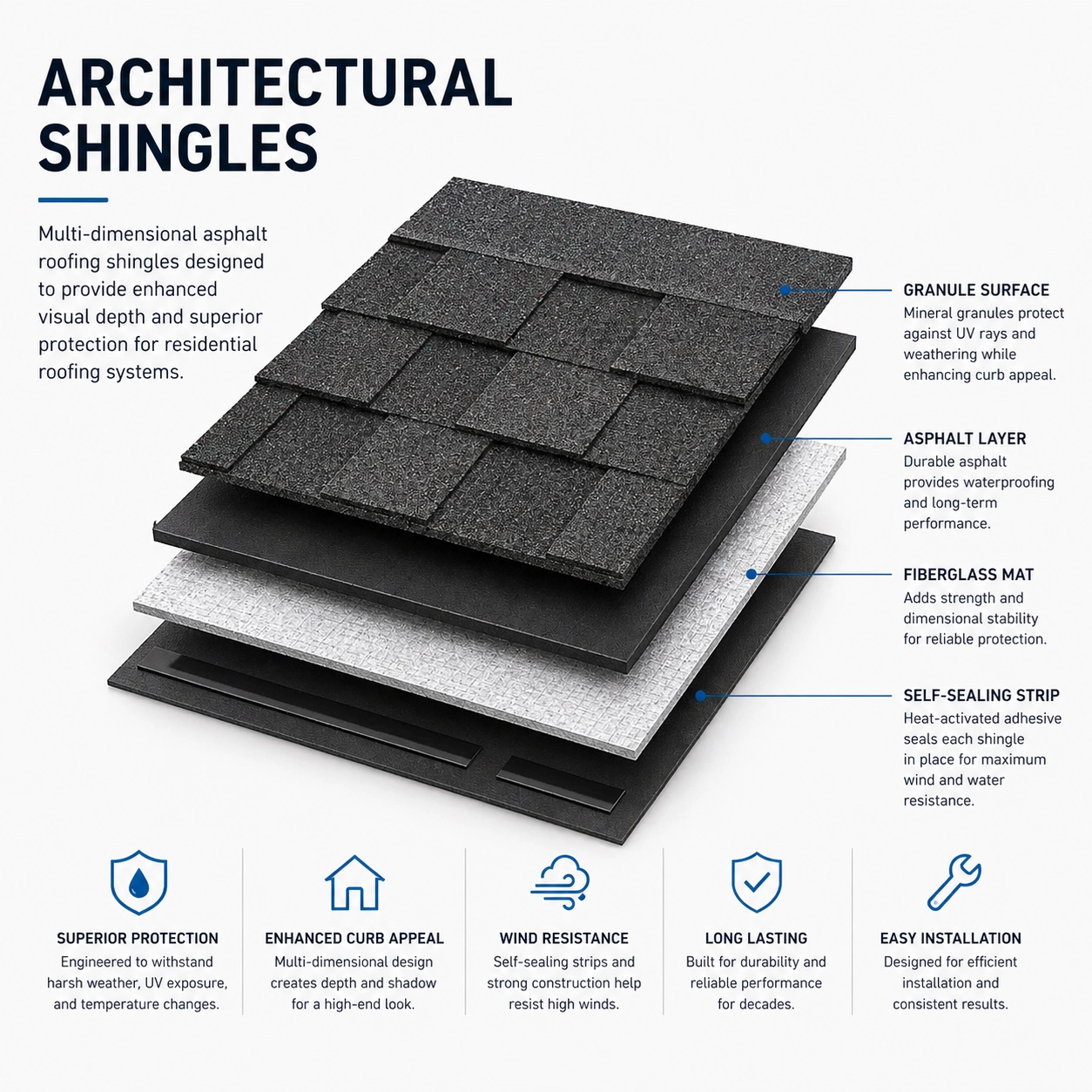
How Architectural Shingles Roofing Enhances Durability, Weather Resistance, and Long-Term Value
Architectural Shingles are a type of asphalt roofing material engineered with a multi-layered, dimensional structure that mimics the appearance of traditional wood shakes or slate. Manufactured from a fiberglass mat base coated with asphalt and mineral granules, architectural shingles are thicker and more contoured than standard three-tab shingles. Their laminated construction creates varied shadow lines and depth, enhancing both the geometry and visual texture of the roof surface across different slopes and pitches.
Functionally, architectural shingles provide superior water drainage due to their precise overlap and interlocking design, which channels precipitation efficiently from ridge to eaves. The increased mass and structural layering improve wind resistance, often rated for uplift pressures exceeding those of basic shingles, and contribute to effective snow shedding on steeper roof pitches. Their robust composition also enhances impact resistance and extends service life, reducing maintenance requirements.
Architectural shingles are commonly specified for residential and light commercial roofing systems where both performance and aesthetics are critical. They are suitable for a wide range of roof geometries, including complex valleys, hips, and ridges, and are frequently chosen for their balance of structural efficiency, weather protection, and architectural appeal.
How Architectural Shingles Are Evaluated for Roofing Performance
Architectural shingles roofing is evaluated for performance based on several key criteria that reflect both material quality and real-world durability. Roofing professionals assess architectural shingles by examining their multi-layered construction, which contributes to enhanced wind resistance, impact resistance, and overall longevity compared to traditional 3-tab shingles. Laboratory testing, such as ASTM D3161 for wind resistance and ASTM D3462 for material integrity, is commonly used to verify that architectural shingles meet or exceed industry standards for durability and weather protection.
Field performance is also a critical factor in evaluating architectural shingles. Installers and inspectors look for consistent granule adhesion, proper sealing, and resistance to common problems with architectural shingles, such as premature cracking or delamination. The lifespan of architectural shingles is influenced by their ability to withstand UV exposure, freeze-thaw cycles, and moisture infiltration, making them particularly suitable for cold climates when properly installed. Additionally, roofing professionals consider installation requirements, compatibility with underlayment and flashing, and the manufacturer’s warranty terms as part of the overall assessment.
Cost-effectiveness and the benefits of architectural shingles are weighed against their initial investment and long-term service life. Professionals evaluate whether the enhanced durability and aesthetic appeal justify the architectural shingles cost, especially when compared to 3-tab shingles. Ultimately, the evaluation process ensures that architectural shingles roofing delivers reliable protection, meets client expectations, and performs well under diverse environmental conditions.
Overview & Key Considerations
What Is Architectural Shingles
Why Architectural Shingles Matters
Benefits of Architectural Shingles
DIMENSIONAL STABILITY
Architectural shingles feature a multi-layered design that resists warping and maintains consistent surface integrity over time.
ENHANCED WEATHER RESISTANCE
Their laminated construction provides superior wind uplift resistance and improved protection against rain, hail, and UV degradation.
EXTENDED SERVICE LIFE
Thicker profiles and advanced asphalt formulations contribute to a longer lifespan compared to traditional three-tab shingles.
INSTALLATION COMPATIBILITY
Architectural shingles are engineered for compatibility with standard nailing patterns and common roof deck substrates, streamlining installation.
Limitations of Architectural Shingles
COLOR FADING RISK
Architectural shingles are prone to accelerated color fading when exposed to intense UV radiation or extreme southern climates.
WIND UPLIFT LIMITS
Despite improved design, architectural shingles can fail under sustained high winds exceeding their rated uplift resistance, especially at roof edges.
MOSS AND ALGAE GROWTH
The textured surface of architectural shingles can retain moisture, increasing susceptibility to moss and algae colonization in humid environments.
WEIGHT LOAD CONSTRAINTS
Architectural shingles are heavier than standard 3-tab shingles, potentially exceeding load limits on older or lightly framed roof structures.
Common Architectural Shingles Problems
GRANULE LOSS ACCELERATION
Accelerated granule loss from architectural shingles exposes asphalt layers, increasing vulnerability to UV degradation and premature cracking.
THERMAL CYCLING CRACKS
Repeated thermal expansion and contraction can cause architectural shingles to crack, leading to moisture intrusion and substrate damage.
ALGAE STAINING DAMAGE
Algae growth on architectural shingles can retain moisture, promoting surface deterioration and reducing material lifespan.
COMPATIBILITY REACTION
Architectural shingles may chemically react with certain underlayments or sealants, resulting in adhesive failure and compromised weatherproofing.
Architectural Shingles Quick Facts
Use Cases for Architectural Shingles
ENHANCED CURB APPEAL
Architectural shingles are chosen for residential roofs where a dimensional, high-end appearance is desired without the weight of slate or tile.
HIGH WIND RESISTANCE
Architectural shingles are specified in regions prone to strong winds due to their heavier construction and improved wind uplift performance.
LONGER LIFESPAN NEEDS
Architectural shingles are selected for projects requiring greater durability and longer service life compared to standard 3-tab asphalt shingles.
MODERATE SLOPE APPLICATIONS
Architectural shingles are installed on moderately sloped roofs where water shedding and aesthetic depth are both important design considerations.