
Copper Roofing Systems
Interlock® Copper Tile Roofing
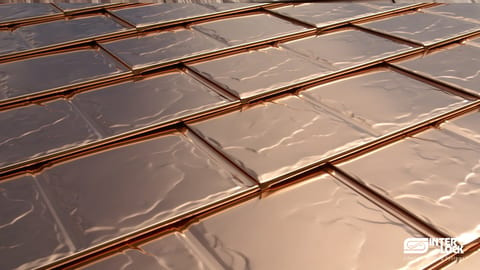
A curved Mediterranean-style profile formed in solid copper, combining a tile-inspired roofline with a natural metal finish.
Compare the profile, natural finish and installation requirements, then request a project-specific quote.
Product overview
At a glance
Interlock offers Mediterranean-style tile panels in solid copper. Copper changes appearance as it weathers. Its patina develops at a rate influenced by exposure and local conditions; a fixed color or uniform weathering schedule should not be assumed. Ask your Interlock representative to confirm the available profile, copper specification, roof slope, fastening, flashing and underlayment details for your project. Fire, wind and impact classifications must be supported by documentation for the specified roof system.
Overview
What is Interlock copper tile roofing?
A curved Mediterranean-style profile formed in solid copper, combining a tile-inspired roofline with a natural metal finish.
Solid copper is the roofing material itself. It differs from an aluminum roof finished in a copper-colored coating. Confirm the material on your quote and request a physical sample before choosing.
Plan the complete roof system
Ask your Interlock representative to confirm the available profile, copper specification, roof slope, fastening, flashing and underlayment details for your project. Fire, wind and impact classifications must be supported by documentation for the specified roof system. Review the current written warranty for coverage, exclusions, registration and transfer requirements. A material warranty is not a promise that every roof component will last indefinitely.
Table of Contents
- What is Interlock copper tile roofing?
- Interlock® Solid Copper Mediterranean Tile for Estates, Architects, and Specifiers
- Why consider solid copper?
- Copper roof specification checklist
- A natural copper finish
- Solid copper or coated aluminum?
- Material recovery and maintenance
- What Homeowners Say About Interlock Metal Roofing
- Copper Tile Roofing: common questions
- Before choosing your copper roof
Who It's For
Interlock® Solid Copper Mediterranean Tile for Estates, Architects, and Specifiers
Compare the roof profile and material sample with your home. Your quote should identify the copper specification, installation scope and warranty documents.
Get Your Free Quote →Request profile drawings, material specifications and installation details for the proposed assembly. Coordinate drainage, adjacent materials and any structural requirements with the project team.
Download Spec Sheet →Discuss product availability, installation guidance and project support with Interlock. Use the current details for the selected profile and assembly.
Become a Certified Installer →Key Advantages
Why consider solid copper?
Architectural profile
A curved Mediterranean-style profile formed in solid copper, combining a tile-inspired roofline with a natural metal finish.
Explore now >Natural finish
Copper changes appearance as it weathers. Its patina develops at a rate influenced by exposure and local conditions; a fixed color or uniform weathering schedule should not be assumed.
Explore now >Documented installation
Ask your Interlock representative to confirm the available profile, copper specification, roof slope, fastening, flashing and underlayment details for your project. Fire, wind and impact classifications must be supported by documentation for the specified roof system.
Explore now >Written warranty
Review the current written warranty for coverage, exclusions, registration and transfer requirements. A material warranty is not a promise that every roof component will last indefinitely.
Explore now >Technical Data
Copper roof specification checklist
| Specification | Details |
|---|---|
| Material | Solid copper. Confirm the specified gauge and profile on your written quote. |
| Roof profile | Mediterranean-style tile panels |
| Finish | Copper changes appearance as it weathers. Its patina develops at a rate influenced by exposure and local conditions; a fixed color or uniform weathering schedule should not be assumed. |
| Roof-system performance | Ask your Interlock representative to confirm the available profile, copper specification, roof slope, fastening, flashing and underlayment details for your project. Fire, wind and impact classifications must be supported by documentation for the specified roof system. |
| Warranty | Review the current written warranty for coverage, exclusions, registration and transfer requirements. A material warranty is not a promise that every roof component will last indefinitely. |
Available Colors
A natural copper finish
Copper changes appearance as it weathers. Its patina develops at a rate influenced by exposure and local conditions; a fixed color or uniform weathering schedule should not be assumed.
Material Comparison
Solid copper or coated aluminum?
Both are metal roofing options. The distinction is the base material and how its appearance changes over time.
| Consideration | Solid copper | Coated aluminum | |
|---|---|---|---|
| Material | Base metal | Solid copper | Aluminum |
| Appearance | Finish | Natural weathering and patina | Factory-applied color finish |
| Project planning | Before ordering | Confirm profile, detailing and warranty | Confirm profile, color, coating and warranty |
Environmental Performance
Material recovery and maintenance
Copper can be recovered and recycled. Plan appropriate drainage and compatible adjoining materials, and follow the installation and maintenance guidance for the complete roof system.
Customer Reviews
What Homeowners Say About Interlock Metal Roofing
★★★★★This is the 3rd roof I have had put on by Interlock Roofing. I put one on my original house, my cottage, and now my new house. They have always done an excellent job, and the aluminum shingles are a great product — light, sturdy, and good-looking, even years down the road.
FAQ
Copper Tile Roofing: common questions
Answers to help you prepare for a project consultation.
Is solid copper the same as a copper-colored aluminum roof?
No. Solid copper is the panel material. A copper-colored aluminum roof uses a finish applied to aluminum. Ask for a material sample and confirm the base metal in your quote.
Will a copper roof change color?
Copper changes appearance as it weathers. Its patina develops at a rate influenced by exposure and local conditions; a fixed color or uniform weathering schedule should not be assumed.
How much does a copper roof cost?
Pricing depends on the roof area, profile, material specification, detailing, access and installation scope. Request a measured, written quote for your property.
Does choosing copper automatically establish a Class A roof rating?
A material description alone does not establish the classification of your proposed roof. Ask for the applicable test or evaluation report and the installation details required for that system.
What should I review before ordering?
Ask your Interlock representative to confirm the available profile, copper specification, roof slope, fastening, flashing and underlayment details for your project. Fire, wind and impact classifications must be supported by documentation for the specified roof system. Review the current written warranty for coverage, exclusions, registration and transfer requirements. A material warranty is not a promise that every roof component will last indefinitely.
At a Glance
Before choosing your copper roof
- A curved Mediterranean-style profile formed in solid copper, combining a tile-inspired roofline with a natural metal finish.
- Copper changes appearance as it weathers. Its patina develops at a rate influenced by exposure and local conditions; a fixed color or uniform weathering schedule should not be assumed.
- Ask your Interlock representative to confirm the available profile, copper specification, roof slope, fastening, flashing and underlayment details for your project. Fire, wind and impact classifications must be supported by documentation for the specified roof system.
- Review the current written warranty for coverage, exclusions, registration and transfer requirements. A material warranty is not a promise that every roof component will last indefinitely.
Documentation
Downloads & Specification Resources
Explore More
Explore Other Interlock Roofing Profiles
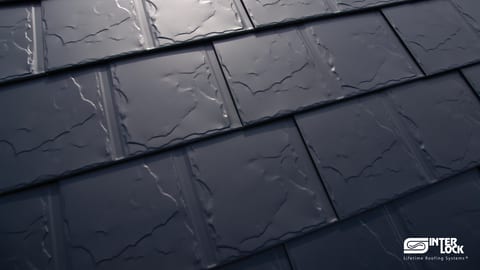
Interlock® Metal Slate Roofing
Interlock® Metal Slate Roofing is a lifetime aluminum system that captures the dimensional beauty of natural slate — ideal for Colonial and Victorian homes — without the weight, cracking, or reinforcement costs of stone. Rust-proof, Alunar®-coated for energy savings, and backed by a transferable Lifetime Limited Warranty.
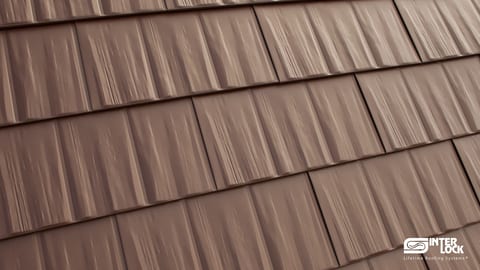
Interlock® Metal Cedar Shingle Roofing
Interlock® Metal Cedar Shingle Roofing is an aluminum shingle stamped with authentic cedar wood-grain texture — the warmth of real cedar with none of the rot, splitting, or discoloration. Rust-proof, virtually maintenance-free, Alunar®-coated, and backed by a transferable Lifetime Limited Warranty.
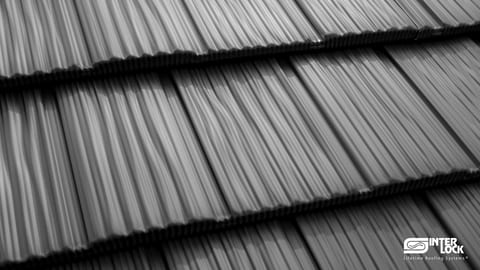
Interlock® Metal Shake Roofing
Interlock® Metal Shake Roofing recreates the deep, hand-split texture of rustic cedar shake in rust-proof aluminum — rugged character for Cape Cod and Craftsman homes without the warping, rot, or fire risk of wood. Alunar®-coated and backed by a transferable Lifetime Limited Warranty.
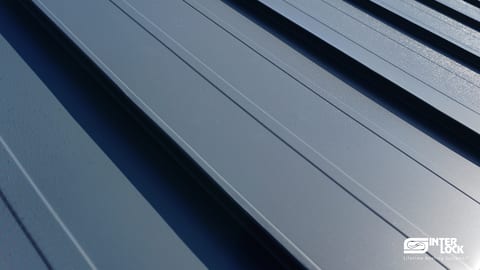
Interlock® Metal Standing Seam Roofing,.
Interlock® Metal Standing Seam Roofing is a mechanical-lock aluminum panel system with clean vertical lines — the signature look of modern and farmhouse architecture. Concealed fasteners, exceptional wind resistance, rust-proof, solar-compatible, and backed by a transferable Lifetime Limited Warranty.
Interlock® Copper Roofing
Interlock® Copper Roofing is the solid-copper tier of Interlock's system, available in all five profiles in 12, 16, and 20 oz copper. A living material, it weathers from bright metallic through bronze to a distinctive verdigris patina — copper's timeless prestige for luxury and heritage homes, backed by a transferable Lifetime Limited Warranty.
Request Your Free Quote
Tell us about your project so we can check installation options in your area.