
What Is Roof Ballast? Properties, Performance, and Uses
TL;DR Ballast Summary
Ballast is a layer of heavy material, such as gravel or pavers, placed on roofing membranes to hold them in place without mechanical fasteners or adhesives. This matters because ballast stabilizes the roof system, protects against wind uplift, and shields the membrane from UV exposure and physical damage. However, ballast adds significant weight, may complicate leak detection, and is less suitable for roofs in high-wind or seismic regions.
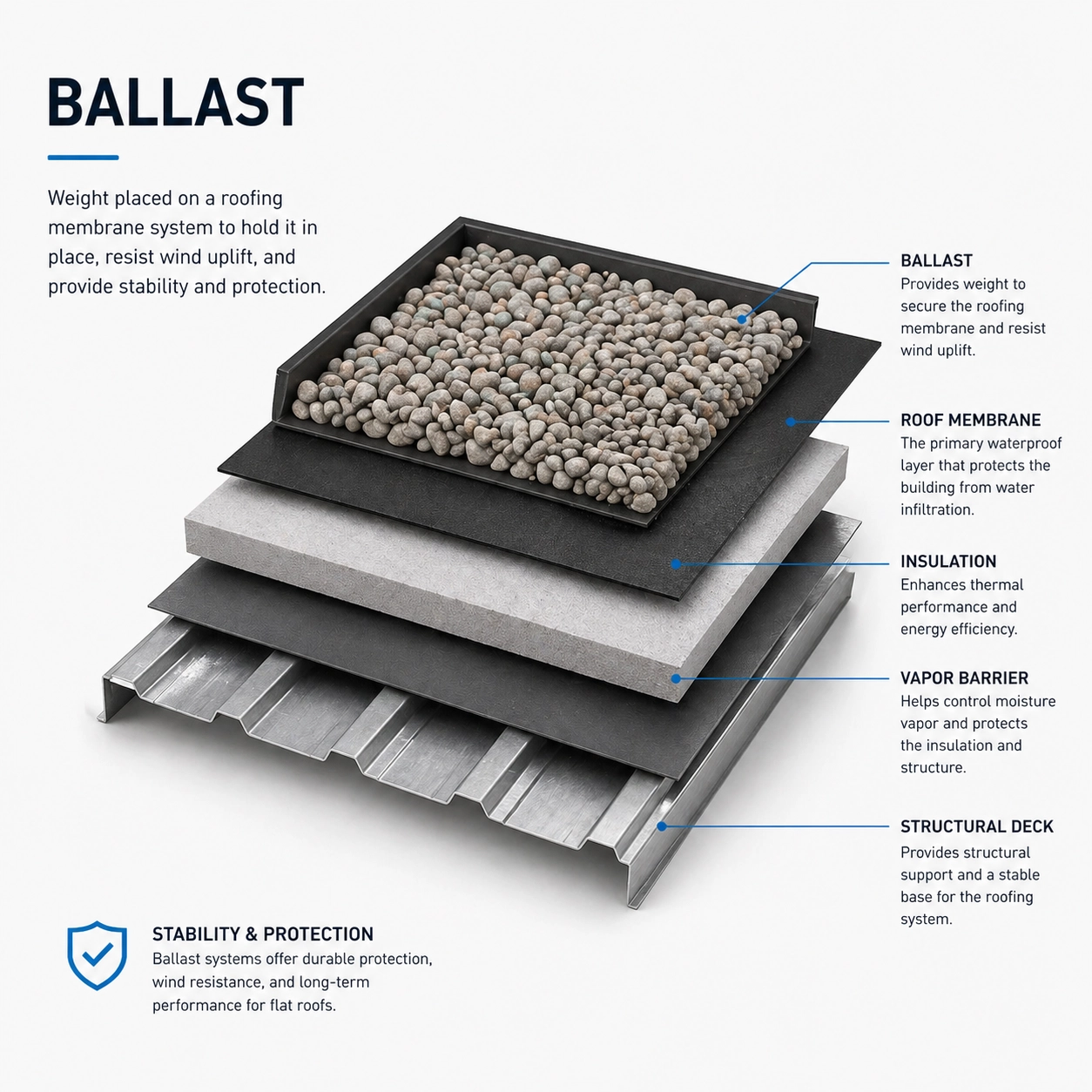
How Roof Ballast Enhances Flat Roof Durability, Wind Resistance, and Cost Efficiency
Ballast in roofing refers to a layer of heavy material, such as gravel, pavers, or concrete blocks, placed over a roofing membrane to secure it against wind uplift and mechanical movement. In a typical ballasted roof system, the ballast is distributed evenly across the membrane, which is laid over insulation and structural decking. This assembly is most commonly used on low-slope or flat roofs, where the roof pitch is minimal and the surface is continuous from ridge to eaves.
The primary function of ballast is to hold the roofing membrane in place without the need for adhesives or mechanical fasteners, enhancing wind resistance and accommodating thermal expansion and contraction. Ballast also provides protection against ultraviolet (UV) radiation, physical damage, and aids in water drainage by creating pathways for runoff. In regions with significant snow loads, the added mass of ballast can contribute to structural efficiency by stabilizing the roof assembly and preventing membrane displacement.
Ballasted roofing systems are typically specified for commercial buildings with large, unobstructed roof areas and adequate structural support to bear the additional weight. They are favored in applications where rapid installation, membrane accessibility, and long-term durability are priorities, especially on roofs with minimal slopes and extensive surface area.
How Roof Ballast Is Evaluated for Roofing Performance
Roof ballast is evaluated for roofing performance based on its ability to provide secure, durable, and stable protection for flat roof assemblies. Roofing professionals assess roof ballast by examining its compatibility with the underlying membrane, the uniformity and size of ballast materials (such as stone or pavers), and the adequacy of coverage to ensure effective wind resistance and membrane protection. The evaluation process includes verifying that the ballast meets project-specific weight requirements, which are determined by factors such as local wind uplift pressures, building height, and exposure category. Properly specified and installed roof ballast helps prevent membrane displacement, puncture, and UV degradation, directly impacting the roof’s long-term service life.
Durability and weathering performance are also key considerations. Professionals inspect the ballast for signs of movement, loss, or degradation over time, especially after severe weather events. The roof ballast lifespan is influenced by the quality of materials, installation practices, and ongoing maintenance. Additionally, the cost and benefits of roof ballast are weighed against alternative systems, such as fully adhered membranes, with attention to factors like installation speed, repairability, and overall system longevity. Ultimately, the evaluation of roof ballast for flat roofs centers on its proven ability to maintain membrane integrity, resist wind uplift, and deliver reliable, cost-effective protection throughout the roof’s service life.
Overview & Key Considerations
What Is Ballast
Why Ballast Matters
Benefits of Ballast
WIND UPLIFT RESISTANCE
Ballast provides mass that helps secure roofing membranes against wind uplift without mechanical fasteners or adhesives.
FIRE PERFORMANCE
Ballast materials such as gravel can enhance fire resistance by creating a protective barrier over combustible roofing components.
UV PROTECTION
Ballast shields underlying roofing membranes from ultraviolet radiation, reducing membrane degradation and extending service life.
THERMAL STABILITY
Ballast moderates temperature fluctuations on the roof surface, helping to maintain consistent membrane performance and reduce thermal stress.
Limitations of Ballast
HEAVY DEAD LOAD
Ballast significantly increases roof dead load, requiring structural verification and potentially limiting use on lightweight or older buildings.
WIND UPLIFT RISK
Loose-laid ballast can shift or displace under high winds, compromising membrane stability and waterproofing integrity.
FREEZE-THAW DEGRADATION
Ballast materials like river rock can trap moisture, accelerating membrane wear and surface abrasion during freeze-thaw cycles.
VEGETATION AND DEBRIS ACCUMULATION
Ballast layers can harbor organic debris, promoting weed growth and obstructing drainage pathways over time.
Common Ballast Problems
BALLAST DISPLACEMENT
Wind-driven displacement of ballast exposes roofing membranes, increasing risk of punctures, UV degradation, and membrane uplift.
BALLAST DEGRADATION
Prolonged UV exposure and freeze-thaw cycles cause ballast materials to break down, leading to reduced protection and membrane abrasion.
BALLAST CONTAMINATION
Accumulation of organic debris or fines within ballast promotes moisture retention, accelerating membrane deterioration and microbial growth.
BALLAST INCOMPATIBILITY
Use of chemically reactive or sharp-edged ballast materials can cause membrane punctures, staining, or accelerated aging of roofing components.
Ballast Quick Facts
Use Cases for Ballast
WIND UPLIFT RESISTANCE
Ballast is used on loose-laid membrane roofs to secure the system against wind uplift without mechanical fasteners or adhesives.
FIRE PROTECTION LAYER
Ballast provides a protective layer over roofing membranes, helping to improve fire resistance on flat or low-slope commercial roofs.
UV MEMBRANE SHIELD
Ballast shields underlying roofing membranes from ultraviolet radiation, extending membrane lifespan in exposed rooftop environments.
WEIGHTED DRAINAGE CONTROL
Ballast assists with water drainage and holds insulation in place on low-slope roofs where positive drainage is critical.