
What Is a Hip Roof? Structure, Design, and Performance
TL;DR Hip Roof Summary
A Hip Roof is a roof type where all sides slope downward to the walls, typically forming a gentle pitch with no vertical ends. This geometry improves wind resistance and drainage, making hip roofs especially effective in hurricane-prone or high-precipitation regions. However, hip roofs are more complex to frame and may increase construction costs compared to simpler roof types.
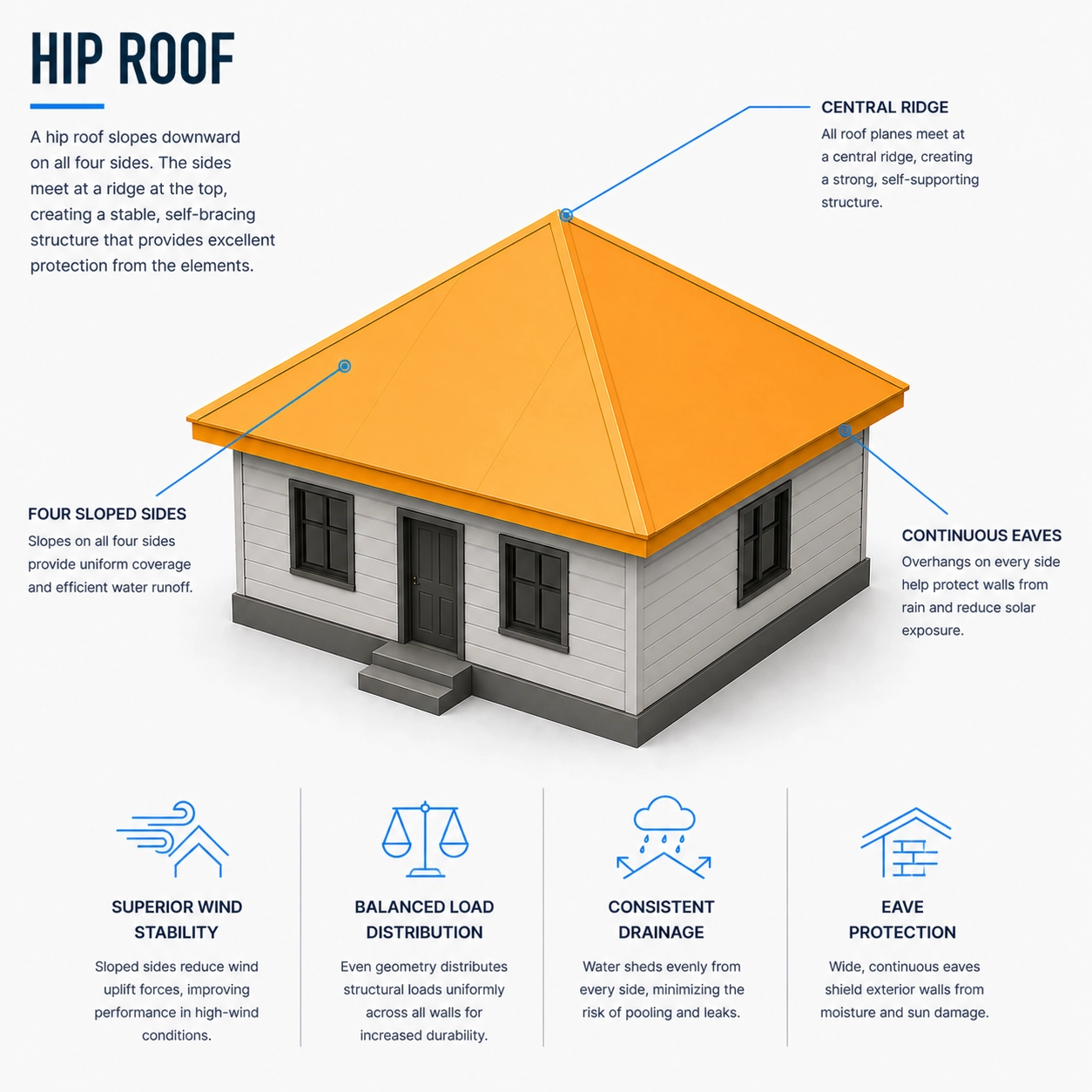
How Hip Roofs Enhance Wind Resistance, Snow Performance, and Drainage Efficiency
A Hip Roof is a type of roof structure characterized by slopes on all four sides, which meet at the roof’s ridge or at a single peak. Unlike gable roofs that have vertical ends, a hip roof’s sides are uniformly pitched, typically with equal roof pitch, and extend down to the eaves on all elevations. The intersection of the roof planes forms external angles known as hips, providing a continuous, streamlined geometry.
Functionally, hip roofs are valued for their superior wind resistance and structural stability, as the inward slope on all sides distributes loads more evenly to the building’s walls. This design enhances water drainage and snow shedding, reducing the risk of water infiltration and excessive snow accumulation. The absence of vertical gable ends also minimizes wind uplift, making hip roofs especially suitable for regions prone to high winds or severe weather.
Hip roofs are commonly used in residential and institutional buildings where durability and efficient weather performance are priorities. While the design may reduce usable attic space compared to gable roofs, its structural efficiency and ability to handle complex building footprints make it a preferred choice for many architectural styles.
How Hip Roof Performance Is Evaluated in Roof Design
Hip roof performance in roof design is evaluated by analyzing several key factors, including structural stability, drainage efficiency, load-bearing capacity, and suitability for specific climates. Roofing professionals assess the hip roof’s four-sided sloped geometry, which contributes to its inherent wind resistance—a critical benefit in high wind areas. The roof’s pitch and overhangs are reviewed to ensure effective water runoff and minimize the risk of water infiltration, directly impacting hip roof drainage efficiency and reducing the likelihood of common problems such as leaks at the hips or valleys.
Load handling is another essential criterion, especially in regions with significant snowfall. Evaluators consider the hip roof’s ability to distribute snow loads evenly across all slopes, which can enhance performance in snow-prone areas compared to other roof types. Structural assessments also include the roof’s framing complexity and the integration of supporting elements, which influence both construction costs and long-term durability.
Architectural suitability and cost are further considerations in hip roof evaluation. Professionals weigh the aesthetic compatibility of hip roof designs for modern homes against factors like hip roof cost estimates and maintenance requirements. Comparative analysis, such as hip roof vs mansard roof, may be conducted to determine the optimal roof type for a given project, factoring in climate, building codes, and owner preferences. Ultimately, a comprehensive evaluation of a hip roof involves balancing performance, risk mitigation, and architectural goals to ensure the roof meets both functional and design expectations.
Overview & Key Considerations
What Is Hip Roof
Why Hip Roof Matters
Benefits of Hip Roof
ENHANCED WIND RESISTANCE
Hip roof geometry with slopes on all sides improves aerodynamic performance and reduces wind uplift risk in severe weather.
IMPROVED DRAINAGE
Multiple roof planes and consistent slopes facilitate efficient water runoff, minimizing standing water and reducing leak potential.
INCREASED STRUCTURAL STABILITY
Intersecting hips and ridges distribute loads evenly, enhancing overall roof rigidity and resistance to structural deformation.
REDUCED EAVE OVERHANG EXPOSURE
Shorter eaves on all sides limit vulnerability to wind-driven rain and help protect exterior walls from moisture intrusion.
Limitations of Hip Roof
COMPLEX FRAMING REQUIREMENTS
Hip roofs require precise structural framing at intersecting hips and valleys, increasing design complexity and risk of framing errors.
REDUCED ATTIC VENTILATION
The inward-sloping geometry of hip roofs limits ridge length, restricting options for effective passive attic ventilation systems.
SNOW LOAD ACCUMULATION
Hip roof valleys can trap snow and ice, increasing localized structural loads and potential for moisture intrusion in cold climates.
LIMITED USABLE ATTIC SPACE
The sloped design of all four sides significantly reduces available attic headroom and usable storage compared to gable roofs.
Common Hip Roof Problems
POOR VALLEY DRAINAGE
Hip roof geometry often creates short, shallow valleys that are prone to water pooling and subsequent leakage during heavy rainfall.
WIND UPLIFT AT RIDGES
Intersecting hips and ridges on hip roofs can experience concentrated wind uplift forces, increasing the risk of shingle or tile displacement.
SNOW LOAD ACCUMULATION
Hip roofs with low pitch may allow snow to accumulate unevenly at hips and valleys, leading to localized structural stress or deformation.
COMPLEX FRAMING STRESS
The intersecting planes and multiple hips of a hip roof can introduce complex load paths, increasing the risk of framing member overstress or failure.
Hip Roof Quick Facts
Use Cases for Hip Roof
HIGH-WIND REGIONS
Hip roofs are commonly chosen in hurricane-prone areas because their inward-sloping sides provide superior wind resistance compared to gable roofs.
TRADITIONAL ARCHITECTURE
Hip roofs are frequently specified for Colonial, French, and Mediterranean-style homes to achieve a balanced, symmetrical appearance.
RAINWATER DRAINAGE
Buildings in regions with heavy rainfall often use hip roofs to promote efficient water runoff from all sides, reducing drainage issues.
ATTIC SPACE LIMITATIONS
Hip roofs are selected when minimal attic or loft space is desired, as their design restricts upper-level volume compared to other roof types.