
What Is Wood Shingle Roofing? Properties, Performance, and Uses
TL;DR Wood shingles Summary
Wood shingles are thin, tapered roofing materials made from natural wood, typically cedar, used to create a weather-resistant roof covering. Their organic composition provides natural insulation and a distinctive appearance, but also makes them susceptible to moisture, fire, and insect damage. Proper installation, regular maintenance, and climate suitability are critical factors in maximizing the lifespan and performance of wood shingle roofs.
How Wood Shingle Roofing Performs in Durability, Lifespan, and Climate Challenges
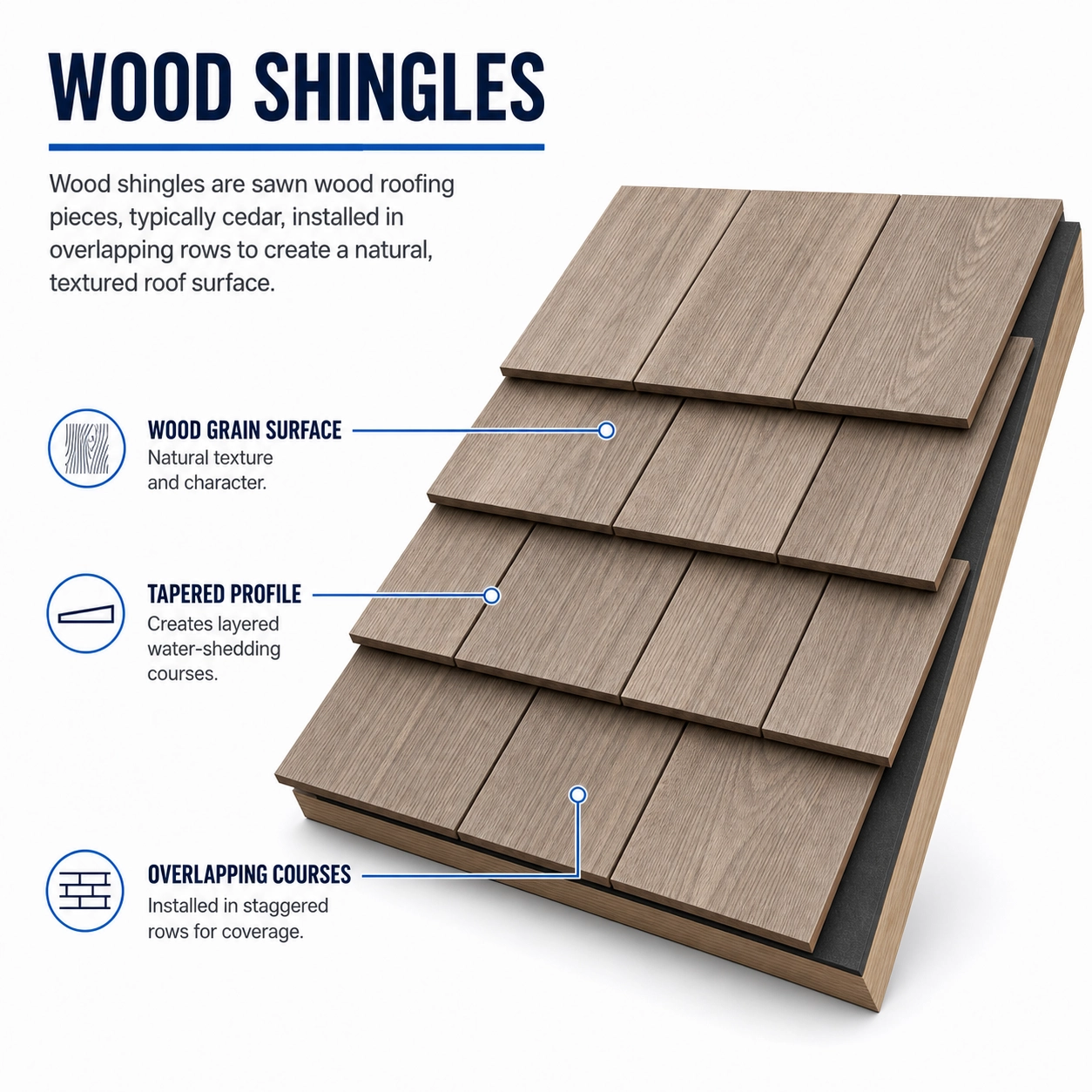
Wood shingles are thin, tapered pieces of natural wood used as a roofing material, typically installed in overlapping courses from the eaves up to the ridge. Each shingle is sawn or split to precise dimensions, allowing for a uniform appearance and tight fit on pitched roofs. The geometry of wood shingles, with their tapered profile and consistent thickness, enables efficient water drainage and promotes rapid snow shedding, especially on steeper slopes.
Structurally, wood shingles are fastened directly to roof decking or spaced sheathing, creating a layered barrier that resists wind uplift and channels water away from vulnerable joints. Their lightweight nature reduces dead load on the roof structure, while the overlapping installation provides redundancy against moisture intrusion. Wood shingles are commonly used in residential and historic applications, particularly where traditional aesthetics or compatibility with existing architectural styles are required. They perform best on roofs with moderate to steep pitch, where gravity assists in water runoff and minimizes the risk of water infiltration at the eaves and valleys.
How Wood Shingles Are Evaluated for Roofing Performance
Wood shingle roofing is evaluated for performance based on several critical factors, including material quality, durability, weather resistance, and installation standards. Roofing professionals assess wood shingles by examining the species and grade of wood, as higher-quality cedar or redwood shingles typically offer superior resistance to decay, insects, and moisture. Durability is further evaluated through real-world exposure and laboratory testing for fire resistance, impact resistance, and dimensional stability, especially important when comparing wood shingles vs asphalt shingles or considering wood shingles for cold climates.
The long-term service life of a wood shingle roof depends on proper installation, ventilation, and ongoing maintenance. Professionals look for precise shingle alignment, adequate spacing for expansion, and correct fastening methods to ensure optimal performance and minimize common wood shingle roof problems such as cupping, splitting, or premature aging. Regular inspections are essential to monitor wood shingle roof lifespan, identify early signs of deterioration, and address maintenance needs promptly.
Cost considerations and climate compatibility also play a role in evaluating wood shingle roofing. While wood shingle roof cost may be higher than some alternatives, the natural aesthetic and potential longevity can justify the investment when installed and maintained correctly. Ultimately, a comprehensive evaluation of wood shingle durability, installation quality, and maintenance requirements informs both homeowners and professionals about the suitability and expected performance of wood shingles in various roofing applications.
Overview & Key Considerations
What Is Wood shingles
Why Wood shingles Matters
Benefits of Wood shingles
NATURAL WEATHER RESISTANCE
Wood shingles provide inherent resistance to wind and moderate precipitation due to their overlapping, tapered design and natural material properties.
LIGHTWEIGHT STRUCTURE
Wood shingles are significantly lighter than many alternative roofing materials, reducing structural load and simplifying installation requirements.
THERMAL INSULATION
Wood shingles offer natural insulating properties, helping to moderate attic temperatures and improve overall building energy performance.
AESTHETIC INTEGRATION
Wood shingles blend seamlessly with traditional and historic architectural styles, supporting preservation and visual harmony in restoration projects.
Limitations of Wood shingles
MOISTURE ABSORPTION
Wood shingles are susceptible to moisture uptake, leading to swelling, warping, and accelerated decay in humid or poorly ventilated environments.
FIRE VULNERABILITY
Wood shingles present a significantly higher fire risk compared to non-combustible roofing materials, especially in wildfire-prone or urban-wildland interface zones.
BIOLOGICAL DEGRADATION
Wood shingles are prone to fungal growth, moss, and insect infestation, which can compromise structural integrity and reduce service life.
DIMENSIONAL INSTABILITY
Wood shingles can expand, contract, or split due to fluctuations in temperature and humidity, causing uneven surfaces and potential water ingress.
Common Wood shingles Problems
UV DEGRADATION
Prolonged ultraviolet exposure causes wood shingles to dry, crack, and lose structural integrity, accelerating premature material failure.
BIOLOGICAL DECAY
Wood shingles are susceptible to rot, mold, and fungal growth when exposed to persistent moisture or inadequate ventilation.
INSECT INFESTATION
Wood shingles can attract termites and carpenter ants, leading to hidden structural damage and compromised roof performance.
CHEMICAL INCOMPATIBILITY
Contact with certain metal fasteners or flashings can trigger corrosive reactions, resulting in staining and accelerated shingle deterioration.
Wood shingles Quick Facts
Use Cases for Wood shingles
HISTORIC RESTORATION
Wood shingles are ideal for restoring historic homes where maintaining original appearance and material authenticity is required.
COASTAL CLIMATE PERFORMANCE
Wood shingles perform well in coastal regions due to their natural resistance to salt air and ability to shed water efficiently.
LIGHTWEIGHT ROOFING NEEDS
Wood shingles are suitable for structures with limited load-bearing capacity, as they are lighter than many alternative roofing materials.
NATURAL AESTHETIC DESIGN
Wood shingles are chosen for projects prioritizing a rustic or natural look, blending seamlessly with wooded or rural environments.