
What Is Snow Guards for Roofs? Function and Role in Roofing Systems
TL;DR Snow guards Summary
Snow guards are roof components designed to hold snow and ice in place, preventing sudden slides from sloped roofs. By controlling the release of accumulated snow, they help protect people, property, and landscaping below from falling debris. Proper placement and integration are critical, as inadequate or incorrectly installed snow guards can lead to system failure and increased liability in snowy climates.
How Snow Guards for Roofs Prevent Damage and Enhance Roof Safety
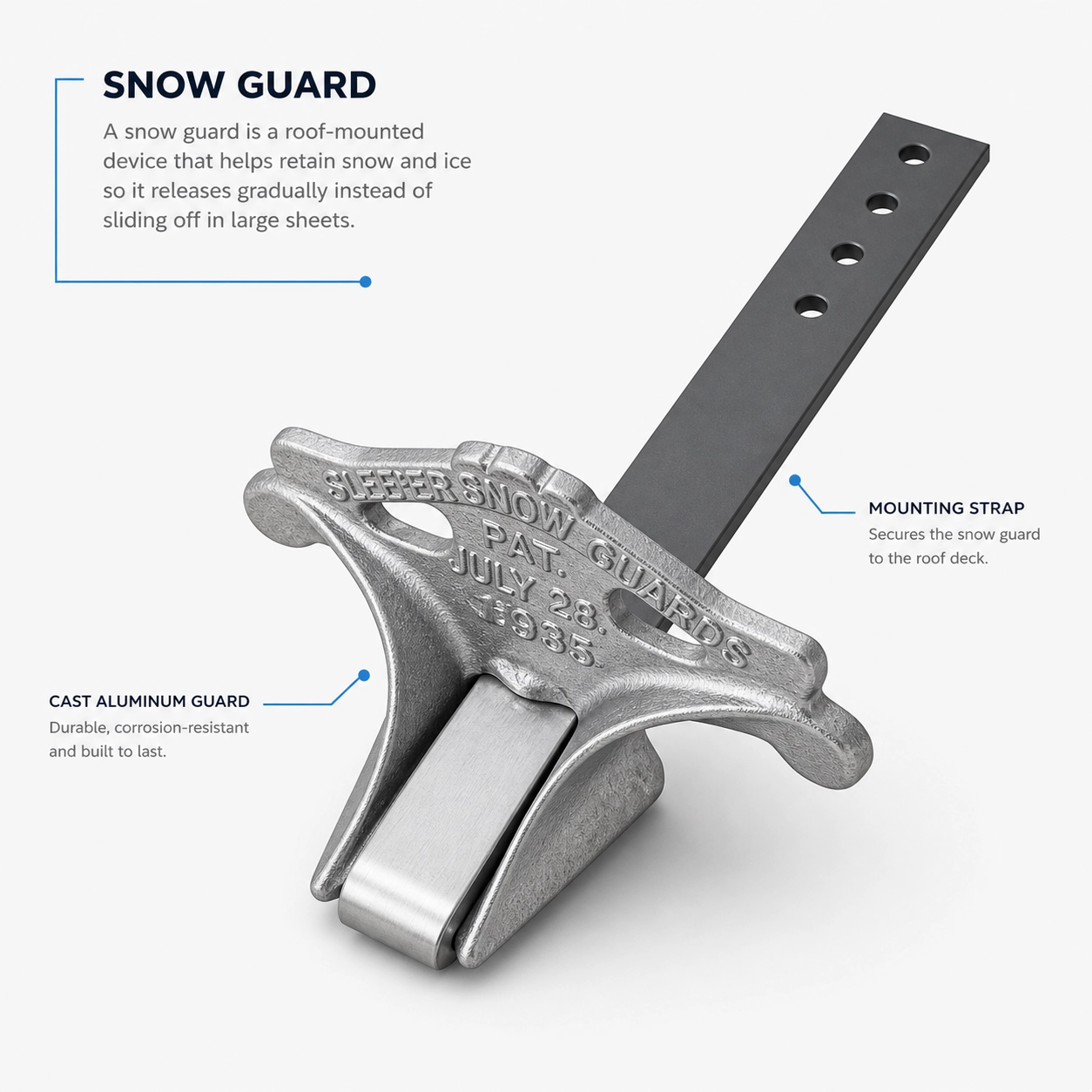
Snow guards are specialized devices installed on sloped roofs to prevent the sudden release of accumulated snow and ice. Structurally, snow guards are typically made from metal or polycarbonate and are mounted above the eaves, along the roof pitch, or near the ridge, depending on the roof geometry and anticipated snow loads. Their design varies from individual pad-style units to continuous rail systems, each engineered to distribute the weight of retained snow evenly across the roof surface without compromising structural integrity.
Functionally, snow guards work by creating friction and physical barriers that hold snow in place, allowing it to melt gradually rather than sliding off in large, hazardous sheets. This controlled snow shedding is critical for protecting gutters, lower roof slopes, landscaping, and pedestrian areas below from damage or injury. Snow guards are most commonly used in regions with significant snowfall, especially on metal roofs or steep pitches where snow movement is more pronounced. Their installation enhances roof safety, preserves water drainage patterns, and helps maintain the long-term performance of roofing assemblies in cold climates.
How Snow Guards Are Evaluated in Roofing Systems
Snow guards for roofs are evaluated within roofing systems based on their placement, function, integration, and compatibility with the roof type and materials. Roofing professionals assess the effectiveness of snow guards by examining their ability to retain snow and ice, preventing sudden slides that could damage property or endanger occupants. Proper placement is critical, especially on steep roofs and metal roofs, where snow guard installation must align with manufacturer guidelines and structural considerations to ensure even load distribution and minimize the risk of snow guard failure.
Integration with the roofing assembly is another key evaluation factor. Snow guards must be compatible with the roofing material—such as standing seam metal, asphalt shingles, or slate—to avoid compromising water management or causing leaks. Fastening methods are scrutinized to ensure secure attachment without damaging the roof membrane or voiding warranties. Roofing professionals also consider the benefits of snow guards on roofs in terms of safety, liability reduction, and protection of gutters and landscaping.
Assessment includes reviewing the expected snow guard lifespan, potential causes of failure (such as improper installation, material incompatibility, or excessive snow loads), and the overall cost for residential roofs. When comparing snow guard vs snow fence solutions, professionals evaluate which option best suits the building’s design, climate, and snow load requirements. Ultimately, the evaluation of snow guards is a holistic process that balances performance, durability, and integration within the roofing system to ensure long-term effectiveness and safety.
Overview & Key Considerations
What Is Snow guards
Why Snow guards Matters
Benefits of Snow guards
SNOW SLIDE PREVENTION
Snow guards prevent sudden snow and ice slides, protecting gutters, landscaping, and pedestrian areas below the roof.
LOAD DISTRIBUTION
They distribute accumulated snow loads more evenly across the roof surface, reducing localized stress and potential structural damage.
ROOF INTEGRITY PROTECTION
By controlling snow movement, snow guards help prevent damage to roofing membranes, flashings, and penetrations caused by sliding ice.
SYSTEM INTEGRATION
Snow guards integrate with other roof components to maintain overall system performance and minimize winter-related roof failures.
Limitations of Snow guards
IMPACT LOAD FAILURE
Snow guards can detach or deform under excessive snow loads, especially if not properly matched to expected regional snow accumulation.
INSTALLATION DEPENDENCY
Effectiveness of snow guards is highly dependent on precise placement and secure attachment to compatible roofing substrates and profiles.
COMPONENT INTERACTION RISK
Improperly installed snow guards can interfere with roof drainage systems or damage adjacent roofing materials, leading to leaks or accelerated wear.
UV AND WEATHER DEGRADATION
Prolonged exposure to ultraviolet radiation and freeze-thaw cycles can cause material fatigue or embrittlement, reducing snow guard lifespan.
Common Snow guards Problems
ICE DAM FORMATION
Improperly placed snow guards can trap snow and ice, increasing the risk of ice dam formation and water intrusion.
FASTENER FAILURE POINTS
Snow guards installed with inadequate fasteners may loosen or detach, creating localized roof leaks and potential fall hazards.
COMPATIBILITY ISSUES
Incompatible snow guard materials can cause galvanic corrosion at attachment points, leading to premature roof component degradation.
LOAD TRANSFER DAMAGE
Incorrectly distributed snow guards can concentrate snow loads, causing localized roof membrane deformation or structural stress.
Snow guards Quick Facts
Use Cases for Snow guards
ICE DAM PREVENTION
Snow guards are installed on sloped roofs to prevent sudden snow slides that can cause ice dams and water infiltration.
PEDESTRIAN SAFETY
Snow guards protect walkways and building entrances by holding snow on the roof, reducing the risk of falling snow injuring people below.
GUTTER PROTECTION
Snow guards help prevent heavy snow from sliding off and damaging gutters or downspouts on metal or slate roofs.
ROOF INTEGRITY
Snow guards distribute snow loads more evenly across the roof surface, reducing localized stress and potential structural damage.