
What Is a Pyramid Roof? Structure, Design, and Performance
TL;DR Pyramid roof Summary
A pyramid roof is a type of hip roof where all four sides slope downwards from a central peak, forming a symmetrical pyramid shape. This geometry promotes efficient water drainage and wind resistance, making it suitable for areas with heavy rainfall or strong winds. However, its design is best suited for square structures and may increase construction complexity and cost compared to simpler roof types.
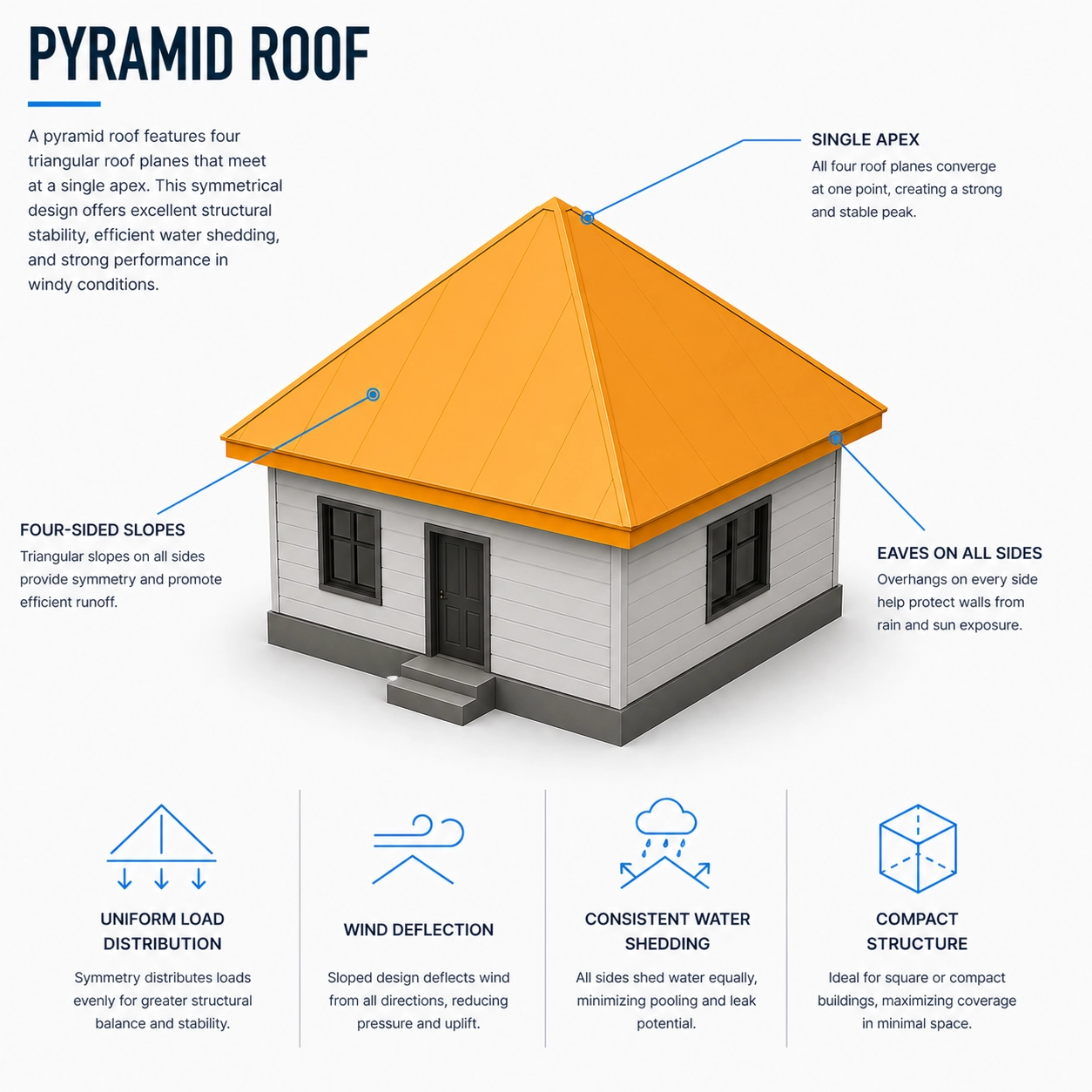
How Pyramid Roof Design Enhances Drainage, Wind Resistance, and Structural Durability
A pyramid roof is a type of hip roof characterized by four identical triangular slopes that converge at a single point or apex, forming a pyramid-like geometry. Unlike gable or standard hip roofs, a pyramid roof has no vertical ends or ridges; all roof planes are pitched uniformly from the eaves upward, creating a symmetrical structure. This design is typically used on square buildings or structures, where each side of the roof mirrors the others in both pitch and length.
The pyramid roof’s geometry provides excellent water drainage and efficient snow shedding, as precipitation naturally flows down the steep, continuous slopes toward the eaves. Its uniform pitch and absence of ridges or valleys reduce the risk of water pooling and minimize potential leak points. The converging slopes also enhance wind resistance, distributing loads evenly across the structure and reducing uplift forces compared to roofs with flat or gabled ends.
Pyramid roofs are commonly found on gazebos, pavilions, small residential buildings, and certain architectural features where a compact, structurally efficient roof is desired. While the design limits usable attic space due to the inward-sloping planes, it offers a visually distinctive profile and robust performance in climates with heavy rainfall or snow.
How Pyramid Roof Performance Is Evaluated in Roof Design
Pyramid roof performance is evaluated by examining several key design and structural factors that influence its suitability for various building applications. Roofing professionals assess the roof’s slope and geometry, which are critical for effective drainage and minimizing water accumulation. The symmetrical, four-sided design of a pyramid roof naturally promotes efficient water runoff, reducing the risk of leaks and standing water, which is especially important in regions with heavy rainfall. This drainage performance is compared to other roof types, such as hip roofs, to determine the best fit for specific site conditions.
Structural evaluation also considers the pyramid roof’s ability to handle wind and snow loads. The aerodynamic shape offers inherent advantages in high wind areas, as the sloped surfaces help deflect wind forces and reduce uplift pressure. Snow load performance is assessed by analyzing the roof pitch and structural support, ensuring the design can safely bear anticipated snow accumulation without excessive deflection or risk of collapse. Professionals also review the integration of ventilation and insulation within the pyramid roof design to maintain energy efficiency and prevent moisture issues.
Cost factors are evaluated based on the complexity of the roof structure, material selection, and installation requirements. The unique geometry of a pyramid roof may increase framing and labor costs compared to simpler roof types, but these are weighed against the long-term benefits of durability, weather resistance, and architectural appeal. Ultimately, the evaluation of a pyramid roof in roof design involves a holistic review of drainage, load handling, climate suitability, and overall performance to ensure the roof meets both functional and aesthetic project goals.
Overview & Key Considerations
What Is Pyramid roof
Why Pyramid roof Matters
Benefits of Pyramid roof
SYMMETRICAL DRAINAGE
The four equal triangular slopes of a pyramid roof promote balanced water runoff from all sides, reducing pooling risk.
WIND RESISTANCE
The compact, steep geometry of a pyramid roof minimizes wind uplift forces, enhancing structural stability in high-wind zones.
RIDGELESS DESIGN
Absence of horizontal ridges eliminates common leak-prone areas, simplifying waterproofing and reducing maintenance needs.
CENTRAL LOAD DISTRIBUTION
The converging planes efficiently transfer structural loads to the building’s center, supporting uniform weight distribution and stability.
Limitations of Pyramid roof
COMPLEX STRUCTURAL SUPPORT
Pyramid roofs require precise load distribution and specialized framing to support their converging slopes at a single apex.
DRAINAGE CHALLENGES
The uniform slope toward a central point can increase risk of water pooling or leakage if drainage is not meticulously designed.
LIMITED ATTIC SPACE
The inward-sloping geometry of a pyramid roof significantly restricts usable attic or upper-level storage volume.
WIND UPLIFT VULNERABILITY
Pyramid roofs present multiple windward faces, increasing susceptibility to uplift forces in high-wind or hurricane-prone regions.
Common Pyramid roof Problems
POOR DRAINAGE AT APEX
The converging slopes of a pyramid roof can cause water to pool at the apex, increasing leak risk.
WIND UPLIFT AT CORNERS
Sharp roof corners and multiple ridges create turbulence, making pyramid roofs susceptible to localized wind uplift and shingle displacement.
SNOW ACCUMULATION AT BASE
Snow tends to accumulate and compact at the lower edges of pyramid roofs, increasing structural load and ice damming risk.
STRUCTURAL STRESS AT RIDGE JUNCTIONS
Intersecting ridges concentrate structural stress at the roof’s apex, potentially leading to framing deformation or failure over time.
Pyramid roof Quick Facts
Use Cases for Pyramid roof
TROPICAL CLIMATE RESILIENCE
Pyramid roofs are ideal for tropical regions, as their steep slopes efficiently shed heavy rainfall and resist wind uplift.
GAZEBO AND PAVILION DESIGN
Pyramid roofs are commonly used for freestanding structures like gazebos, providing symmetrical coverage and a visually balanced appearance.
SQUARE BUILDING APPLICATION
Pyramid roofs suit square floor plans, offering uniform load distribution and consistent eave heights on all sides.
TRADITIONAL ARCHITECTURE INTEGRATION
Pyramid roofs complement traditional architectural styles, such as pagodas or certain colonial buildings, where a central peak is desired.