

Rainwater Harvesting From Your Roof: The Complete Guide
Quick Answer
Factory-coated metal is the most recommended roof for rainwater harvesting, and coated aluminum sheds the least zinc of any roof studied (under 0.002 mg/L in compiled runoff data). But no roof makes rain drinkable on its own: garden use needs only screens and a first-flush diverter, while drinking water needs filtration, disinfection and regular lab testing whatever the roof.
Interlock homeowners ask us two questions about rainwater more than any others: Can I collect it from my roof? and Is it safe? This guide answers both, using university research, government health guidance and the North American standard for rainwater systems. It is written for two kinds of readers. If you're filling your first rain barrel, start with the Beginner Path. If you're designing a whole-house system, planning to drink the water, or comparing roofing materials in depth, jump to the Advanced Path.
Choose your path
| If you are… | Start here | You'll learn |
|---|---|---|
| New to rainwater harvesting, watering a garden or lawn | Beginner Path | What you can use rainwater for, the rules, a starter setup, how much water you'll collect, and basic upkeep |
| Planning a large tank, indoor use or drinking water, or choosing a new roof | Advanced Path | A material-by-material comparison of 14 roof types, the science on coatings and PFAS, site risks, sizing math, treatment, testing and codes |
| Looking for a quick answer | Frequently asked questions | Short, direct answers |
Beginner Path
What is rainwater harvesting?
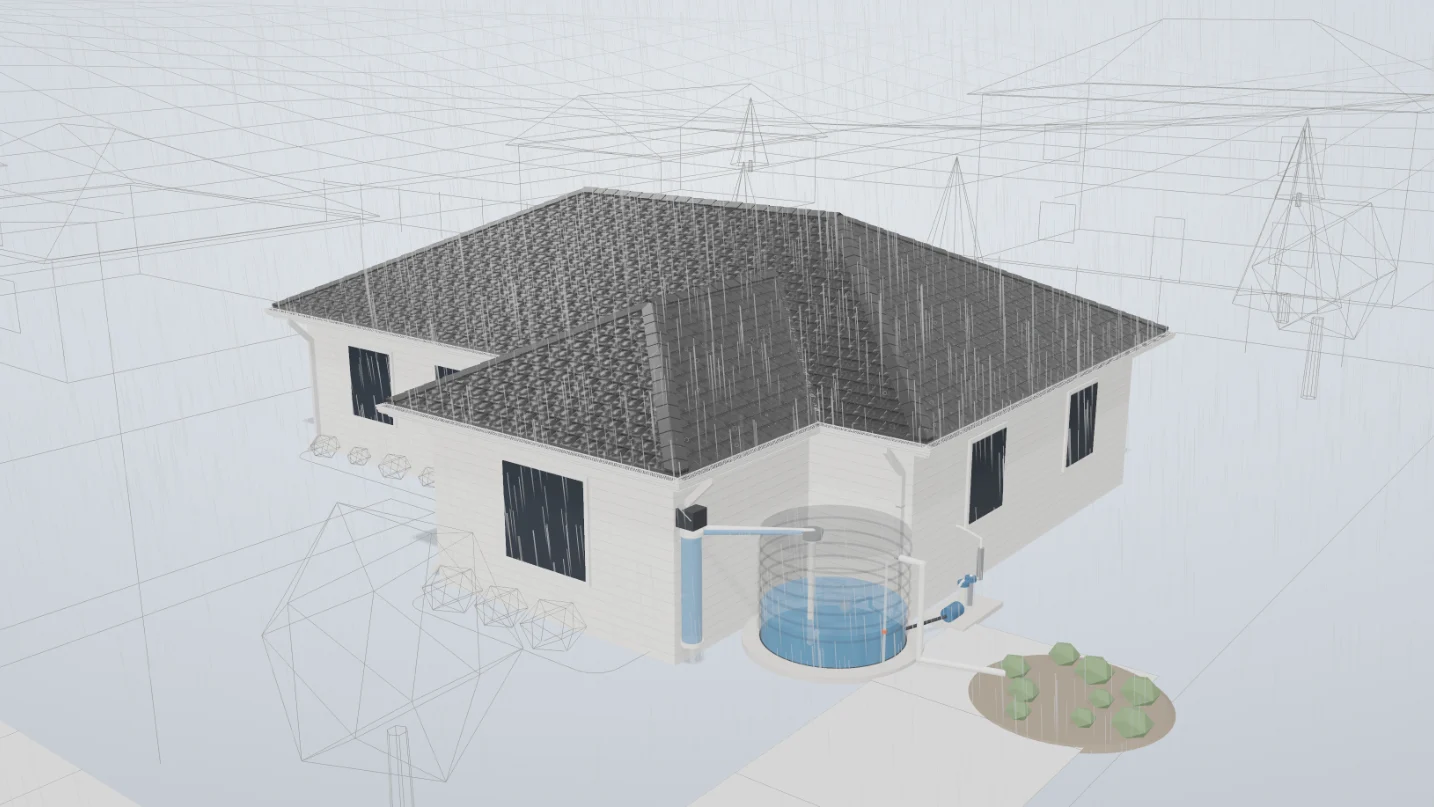
Rainwater harvesting is collecting the rain that runs off your roof and storing it to use later. A simple system has five parts: the roof (the catchment), gutters and downspouts, a screen or filter, a first-flush diverter that throws away the dirtiest water, and a storage container such as a rain barrel or tank 19.
What can I use harvested rainwater for?
Without treatment, rainwater is best used outdoors:
- Watering flower beds, shrubs, lawns and vegetable gardens
- Washing cars, patios and outdoor furniture
- Topping up ponds and water features
With a properly designed and approved system, it can also flush toilets and supply washing machines. Drinking, cooking, brushing teeth and bathing require treatment, testing and, in most places, approval from your local health or building authority 15,20.
Is rainwater harvesting legal?
In Canada, collecting rain from your own roof for outdoor use is widely permitted, and some municipalities and regional districts pay rebates for it 22. In the United States, most states allow it and some encourage it with tax incentives; a few regulate how much you can collect or how it can be used 15,17. Rules for drinking rainwater vary by province, state and city, so check with your local health authority before connecting harvested water to a tap you will drink from. See the province-by-province and state-by-state tables in the Advanced Path.
Does my roof matter if I'm only watering the garden?
A little. Most roofs are fine for ornamental gardens. For vegetables, avoid water from treated wood shakes and copper roofs, which can carry arsenic and copper into soil 4,7. Water from an Interlock® aluminum roof is well suited to food gardens.
Your first setup: a rain barrel in an afternoon
- Pick a downspout that drains a good-sized section of roof, away from chimneys and overhanging trees.
- Set the barrel on a solid, level base a little off the ground so a watering can fits under the tap. A full 200 L (55 US gallon) barrel weighs about 200 kg (440 lb).
- Use a barrel with a sealed, screened lid to keep out mosquitoes, leaves and small animals 23.
- Add a first-flush diverter or a downspout diverter so the first dirty water bypasses the barrel 28.
- Plan the overflow. Route overflow at least 1.5 m (5 ft) away from your foundation, or into a second barrel.
- Disconnect before freezing. In Canada and the northern U.S., drain and store barrels before the first hard frost.
How much water will my roof collect?
The math is simple:
Example: a 2,000 sq ft roof in a 1-inch rainfall collects about 1,100 US gallons. A 150 m² roof in a region with 1,000 mm of rain a year can collect about 135,000 litres a year. Use the plan area of the roof (its footprint), not the sloped surface area.
Smooth roofs shed more of the rain that falls on them. Asphalt shingles collect about 85% of rainfall; smooth enamelled metal collects over 95% 16.
Beginner do's and don'ts
Do: keep gutters clean, screen every opening, use a first-flush diverter, keep the barrel covered, and use the water within a few weeks in warm weather.
Don't: drink untreated rainwater from any roof 15; connect a rain barrel to your household plumbing; collect from roof sections near a chimney or wood-stove flue 25; or use moss killers, zinc strips or copper strips on a roof you collect from.
Seasonal checklist
| Season | Task |
|---|---|
| Spring | Reconnect barrels, flush gutters, check screens, empty and reset the first-flush diverter |
| Summer | Check for mosquito larvae, use stored water regularly, trim branches over the roof |
| Fall | Clear leaves from gutters and screens after leaf drop |
| Winter | Drain and store barrels in freezing climates; check for ice damage in spring |
Ready for more? Continue to the Advanced Path.
Advanced Path
Roofing materials compared: which roof is best for rainwater harvesting?
This is the most detailed part of the guide. We compared 14 common roofing materials using five sources of measured data: the University of Texas at Austin study for the Texas Water Development Board 1,2, the Washington State Department of Ecology roofing study 4, the Minnesota Pollution Control Agency's compilation of roof-runoff research 5, a Korean pilot-roof study 6 and Penn State research on garden use 7.
At a glance: the scorecard
| Roofing material | Main concern in runoff | Drinking water (with treatment) | Food garden | Overall for harvesting |
|---|---|---|---|---|
| Coated aluminum (Interlock®) | Very low zinc; no steel, no lead | Best | Best | Best |
| Factory-coated (PVDF) steel | Low zinc; lead at or below detection in one full-scale test | Very good | Very good | Very good |
| Factory-painted (polyester/SMP) steel | Low to moderate zinc | Good | Good | Good |
| Uncoated galvanized or Galvalume® steel | Zinc, rising with age | Fair | Fair | Fair |
| Stone-coated steel | Shed granules; little published runoff data | Ask the maker for test data | Good | Fair to good |
| Glazed clay tile | Some copper; moss and debris between tiles | Good | Good | Good |
| Concrete (cement) tile | High pH early on; aluminum and iron in first flush | Good | Good | Good |
| Natural slate | Little data; often paired with lead or copper flashing | Fair, check flashing | Good | Fair to good |
| Asphalt (composite) shingles | Organic carbon, copper from algae-resistant granules, grit | Not recommended | Acceptable | Fair |
| Rubber (recycled tire) and synthetic shingles | Zinc and tire chemicals | Not recommended | Use caution | Poor |
| Untreated wood shakes | Mould, organic matter | Not recommended | Acceptable | Poor |
| Treated wood shakes | Arsenic, copper | Avoid | Avoid | Avoid |
| Copper | Copper | Avoid | Use caution | Avoid |
| EPDM, PVC and other membranes | Zinc (EPDM), arsenic biocide (PVC) | Not recommended | Use caution | Poor |
Measured metals in roof runoff
These ranges were compiled by the Minnesota Pollution Control Agency from more than a dozen peer-reviewed studies 5. They are typical runoff concentrations, before any first-flush diversion or treatment. For scale, Health Canada's health-based limit for aluminum in drinking water is 2.9 mg/L 31, and the U.S. EPA lead action level is 0.015 mg/L 1.
| Metal | Roof material | Runoff concentration (mg/L) |
|---|---|---|
| Zinc | Aluminum, stainless steel, titanium, polyester, gravel | less than 0.002 |
| Zinc | Coated galvanized steel | 0.2 to 1 |
| Zinc | New uncoated galvanized steel | 0.5 to 10 |
| Zinc | Old uncoated galvanized steel | 1 to 38 |
| Copper | Uncoated galvanized steel | less than 0.003 |
| Copper | New asphalt shingles | 0.01 to 0.2 |
| Copper | Clay tiles | 0.003 to 4 |
| Copper | Aged (patinated) copper | 0.9 to 9.7 |
| Copper | New cedar shakes | 1.5 to 27 |
| Lead | Coated and uncoated galvanized steel | less than 0.0001 to 0.006 |
| Lead | Painted materials | less than 0.002 to 0.6 |
Coated aluminum (Interlock® roofing systems)
What it is. Every Interlock® roofing system is made from heavy-gauge aluminum, and the thickness depends on the profile: 0.019″ (0.483 mm) 3105-H24 alloy for Slate and Cedar Shingle, 0.0276″ (0.701 mm) 3003-H24 or 3105-H24 alloy for Shake and Mediterranean Tile (both per ICC-ES evaluation report ESR-1790), and 0.028″ (0.71 mm) aluminum for Standing Seam. Every profile is finished with the Alunar Coating System, a factory-applied 70% PVDF (polyvinylidene fluoride) finish engineered to meet AAMA 2605, the highest North American performance specification for architectural coatings. There is no steel core and no zinc coating, and no lead is used in the panels.
What gets into the water. Aluminum roofs do not shed meaningful zinc: compiled runoff data show less than 0.002 mg/L, the lowest category in the Minnesota table 5. The closest full-scale test of the same coating class is the UT Austin study of a PVDF (Kynar®)-coated roof. That roof was Galvalume® steel, not aluminum, and even with a zinc-bearing steel base, every metal measured after the first flush met U.S. EPA drinking-water standards: aluminum under 0.0067 mg/L, zinc 0.057 to 0.177 mg/L and lead at or below the detection limit 1. An aluminum roof with the same type of finish removes the steel and zinc from the picture altogether.
Drinking water. Best candidate, with first-flush diversion, filtration and disinfection. Smooth, hot metal also helps: researchers in Texas and Korea both found lower bacteria counts on metal roofs, likely because sun and heat inactivate microbes 1,6.
Garden. Excellent.
Verdict: the strongest roof surface for rainwater harvesting in this comparison.
Factory-coated steel (PVDF or polyester/SMP paint)
What it is. Galvanized or Galvalume® steel with a baked-on paint system. PVDF finishes are the premium tier; silicone-modified polyester (SMP) is the common mid-grade.
What gets into the water. The paint reduces zinc compared with bare steel: coated galvanized steel sheds about 0.2 to 1 mg/L zinc versus up to 38 mg/L for old bare steel 5. Washington Ecology found that a factory-painted galvanized panel released zinc at levels an order of magnitude lower than bare Zincalume® 4. As paint wears or is scratched, cut edges and scratches expose the zinc layer underneath.
Drinking water. Very good to good with treatment. New Zealand's building research body lists factory-coated zinc/aluminum-coated steel as suitable for collecting drinking water 32.
Verdict: a sound choice; PVDF finishes hold up longer than polyester.
Uncoated galvanized and Galvalume® steel
What it is. Bare steel with a zinc or zinc-aluminum coating. Common on barns and sheds.
What gets into the water. Zinc, and more as the roof ages: 0.5 to 10 mg/L new and 1 to 38 mg/L old 5. UT Austin's pilot Galvalume® roof had the highest median zinc of its test roofs, and its first-flush water exceeded U.S. EPA secondary limits for aluminum and iron 1. Older metal roofs are often fastened with lead-washer nails, which can leach lead 16.
Drinking water. Fair. Many installers use it successfully with good first-flush diversion and treatment, and a Korean study rated galvanized steel the most suitable of four roofs tested 6.
Verdict: workable, but zinc builds up in garden soil over time and the roof's contribution grows as it ages.
Stone-coated steel
What it is. Zinc-aluminum-coated steel panels with crushed stone granules bonded to the surface with an acrylic resin.
What gets into the water. We found no independent, peer-reviewed runoff study of stone-coated steel. Expect shed granules in gutters and tanks as the roof ages, a rough surface that holds more dust and debris than smooth metal, and exposed steel at cut edges and fasteners.
Drinking water. Ask the manufacturer for NSF P151 or equivalent test data before relying on it 30.
Verdict: fair to good for gardens; unproven for drinking water.
Glazed clay tile
What it is. Fired clay tiles, glazed or unglazed.
What gets into the water. Generally clean, though compiled data show copper from 0.003 to 4 mg/L in clay-tile runoff 5. Debris and moss collect between tiles, so the Minnesota manual recommends periodic cleaning 5. Rain Harvesting, an Australian manufacturer, lists glazed, well-fired tiles among the most suitable surfaces 28.
Verdict: good, with regular cleaning.
Concrete (cement) tile
What it is. Moulded tiles of cement, sand and pigment.
What gets into the water. UT Austin rated concrete tile a good candidate. Its first-flush water was more alkaline than other roofs, sometimes above pH 8.5, and exceeded U.S. EPA secondary limits for aluminum and iron before the first flush was diverted 1. The higher pH can actually help offset rain's natural acidity.
Verdict: good. Porous tile is slower to dry and can hold moss and bacteria.
Natural slate
What it is. Split natural stone.
What gets into the water. Very little published data. A 2025 South African study that included slate, steel, concrete and aluminum roofs found no significant difference in water quality between roof types; microbial contamination was the problem on all of them 9. Slate roofs are often flashed with lead or copper, which matters more than the stone.
Verdict: fair to good, once lead and copper flashings are dealt with.
Asphalt (composite) shingles
What it is. A fibreglass mat coated in asphalt and covered in mineral granules. Most shingles sold in humid climates use copper-containing granules to resist algae, which work by releasing copper into rainwater.
What gets into the water. Higher dissolved organic carbon when new, which can react with chlorine disinfectant to form by-products 37. UT Austin's shingle roof had the highest copper of its pilot roofs, though below the action level 1. Granules wash into gutters and tanks. Shingles made before 1980 may contain traces of asbestos 5.
Drinking water. The Texas Manual on Rainwater Harvesting advises against composite or asphalt shingles for drinking-water systems 17, and Minnesota recommends them for non-potable use only 5.
Verdict: fine for gardens; not recommended for drinking water.
Rubber and synthetic shingles
What it is. Shingles made from recycled tires (crumb rubber) or from virgin polymers designed to look like slate or shake.
What gets into the water. Tire rubber contains roughly 1 to 2% zinc by weight 12, and zinc leaching from crumb rubber increases with lower pH and longer contact time 11. Rain is naturally slightly acidic. Tire-derived rubber also carries other additives studied for their toxicity to aquatic life. Washington Ecology found arsenic, used as a biocide, leaching from a PVC roofing panel 4; check what additives a synthetic product contains.
Verdict: not recommended for drinking water; use caution on food gardens.
Wood shakes and shingles
What it is. Split or sawn cedar, untreated or pressure-treated.
What gets into the water. Treated shakes are among the worst roofs for harvesting: Washington Ecology measured arsenic from 692 to 4,690 µg/L and copper from 601 to 3,190 µg/L in runoff from a chromated copper arsenate (CCA) treated shake 4. Even new cedar shakes shed copper at 1.5 to 27 mg/L in compiled data 5. Untreated wood holds moisture and supports mould, algae and insects 5,16.
Verdict: avoid treated wood entirely. Untreated wood is for irrigation only 5.
Copper
What it is. Sheet copper, standing seam or shingles.
What gets into the water. The highest copper of any material tested. Washington Ecology measured 1,035 to 3,380 µg/L from a copper panel 4, and aged copper still sheds 0.9 to 9.7 mg/L 5. Copper runoff is a known hazard to fish and aquatic life.
Verdict: avoid for drinking water; use caution on gardens and near ponds or streams.
EPDM, PVC and other membranes
What it is. Single-ply rubber or plastic membranes used on low-slope roofs.
What gets into the water. Washington Ecology measured zinc from 44 to 313 µg/L from EPDM and arsenic from 22 to 117 µg/L from PVC 4. Minnesota recommends sheet roofing for non-potable use only 5.
Verdict: poor for drinking water unless the product is certified to NSF P151 30.
Green (vegetated) roofs
Green roofs gave the cleanest water for turbidity and some metals in the UT Austin study, but high dissolved organic carbon makes them a poor choice if you disinfect with chlorine 1,37. Good for irrigation.
What rain touches on an Interlock® roof
If you're harvesting from an Interlock roof, these are the surfaces in the water path:
| Component | Material | In the water path? |
|---|---|---|
| Roof panels (all profiles and colours) | Heavy-gauge aluminum (0.019″ to 0.028″ depending on profile), Alunar Coating System finish | Yes, the main catchment surface |
| White back coat | Coating on the underside of each panel | No |
| Ridge membrane | Membrane laid under the ridge caps | No |
Two things work in a harvester's favour. Because Interlock panels lock together and hide their nails, rain flows over the coated face of the next panel rather than over exposed screw heads and rubber washers. And because the panels are aluminum, colours with copper-sounding names (such as Copper Penny) are still coated aluminum, not copper.
Coatings and PFAS: what we know and what we don't
PVDF finishes are fluoropolymers, and advocacy groups and some regulators include fluoropolymers in broad definitions of PFAS (per- and polyfluoroalkyl substances, often called "forever chemicals") 14. Here is the evidence as it stands:
- PVDF is a large, stable polymer baked onto the metal at the factory. Its stability is why it's used: it resists breaking down in sunlight and rain.
- We found no published study that measured PFAS in runoff from a PVDF-coated roof. We won't claim there is zero, and we won't repeat a scare that hasn't been measured.
- Rain carries PFAS before it reaches any roof. A 2022 study led by Professor Ian Cousins at Stockholm University found PFAS in rainwater worldwide, including Antarctica and the Tibetan Plateau, above recent U.S. EPA advisory levels 13.
- The answer is treatment and testing. If you plan to drink harvested rainwater, include activated carbon or reverse osmosis in your treatment train, and include PFAS in your water tests.
Where you live: environmental risks to water quality
Rain collects whatever is in the air before it lands. Health authorities point to these local factors:
| Risk | Why it matters | What to do |
|---|---|---|
| Heavy industry, smelters, incinerators, very heavy traffic | Airborne metals and chemicals settle on roofs. South Australia's health department advises against collecting rainwater for drinking in these areas 24. | No agency sets a fixed safe distance. If the source is visible, smellable or upwind, use rainwater outdoors only, or treat and test more often. |
| Wood stoves and chimneys, including your own | Soot can carry hydrocarbons 16. NSW Health advises against collecting from roof sections with wood-burner flues 25. | Divert those roof sections away from the tank. |
| Wildfire smoke, ash and fire retardant | Ash, debris and retardant land on roofs and wash into tanks 26. | Disconnect downspouts when fire is nearby; reconnect only after the roof is cleaned and smoke has cleared 26,35. Drain and clean a drinking tank if ash or retardant got in. |
| Farm spraying | Pesticide drift settles on roofs. | Divert more first-flush water and test. |
| Trees and birds | Leaves feed bacteria; droppings carry pathogens. Contamination from droppings is the greatest health risk in rainwater tanks 25. | Trim branches back, screen gutters, and size first-flush diversion for a dirty roof. |
| Lead flashing or old lead paint | Lead leaches into runoff. Queensland building rules say lead flashing must not be used on roofs that collect drinking water 27. | Replace lead flashing with coated aluminum or another lead-free material 27. |
| Coastal salt air | Not a drinking-water health concern. | Choose a roof finish built for coastal exposure. |
Local conditions can outweigh the roof itself. A 2022 study in Ghana found runoff from all four roof types tested, including aluminum and galvanized steel, exceeded World Health Organization drinking limits for several metals and bacteria 10, while a 2025 South African study found no significant difference between roof types and blamed microbes, not metals 9. The common thread: test your own water.
Sizing a first-flush diverter
A first-flush diverter fills with the first, dirtiest water off the roof, then seals so cleaner water flows on to the tank. UT Austin found all metal concentrations fell after the first flush 2.
Formula: litres to divert = roof area (m²) × a pollution factor of 0.5 L/m² for a clean, open site, rising to 2 L/m² where there are trees, birds or air pollution 28.
| Roof area feeding the diverter | Clean site (0.5 L/m²) | Dirty site (2 L/m²) |
|---|---|---|
| 50 m² (540 sq ft) | 25 L | 100 L |
| 100 m² (1,076 sq ft) | 50 L | 200 L |
| 150 m² (1,615 sq ft) | 75 L | 300 L |
| 200 m² (2,153 sq ft) | 100 L | 400 L |
For drinking-water systems, some U.S. designers divert 0.05 to 0.1 US gallons per square foot of roof, or 100 to 200 gallons for a 2,000 sq ft house 29. One metre of 100 mm pipe holds about 8.8 litres, which helps size a standpipe diverter 28. Size each downspout separately, and make the diverter easy to open and clean, or it will end up disabled.
Storage: tanks and cisterns
- Material: use tanks made for drinking water, certified to NSF/ANSI 61 where available. Avoid "swimming-pool grade" liners, which may contain algaecides 23.
- Light and access: opaque, sealed tanks prevent algae; screened vents and overflows keep out insects and animals 23.
- Calm inlet and floating intake: a calming inlet stops settled sediment being stirred up, and a floating extraction draws water from just below the surface, where it's cleanest.
- Overflow: route it to a rain garden or storm drain, away from foundations.
- Sizing: storage depends on rainfall pattern and demand. One Texas designer uses about 5,000 gallons per occupant to carry a household through the dry summer months 29; wetter climates such as coastal British Columbia need less, since rain falls more evenly through the year.
- Freezing climates: bury tanks below the frost line or locate them in a heated space, and drain above-ground lines before winter.
Treatment for drinking water
British Columbia's Ministry of Health classifies harvested rainwater as surface water, held to the same treatment objectives as a lake or stream 20. A typical treatment train:
- Leaf screens and first-flush diversion at the roof 15,28.
- Settling in a calm-inlet tank.
- Sediment filtration, coarse then fine.
- Activated carbon for taste, odour, organics and some PFAS.
- Reverse osmosis (optional) for the broadest chemical reduction.
- Ultraviolet disinfection to kill bacteria, viruses and parasites. Chlorine also works, but can form by-products if the water carries organic carbon 37.
- Point-of-entry protection: keep rainwater plumbing completely separate from city or well water. The CDC warns that mixing rainwater into treated water can make the treated water less safe 15.
Rainwater is naturally soft and slightly acidic, so it can pull copper and lead from household plumbing. Use lead-free fittings, consider pH correction, and flush drinking taps for 2 to 3 minutes at the start of each day 25.
Testing program
| What to test | Why | When |
|---|---|---|
| Total coliform and E. coli | Bacteria are the most common problem; every roof in the UT study exceeded coliform standards after the first flush 1 | Before first use, then on a regular schedule and after any change to the system |
| Lead, copper, zinc, aluminum, iron | Roof, gutters, fittings and plumbing | Before first use and yearly |
| pH and turbidity | Corrosion and treatment performance | With each bacteria test |
| PFAS | Present in rain worldwide 13 | Before first use if you drink the water |
A Stephen F. Austin State University study of Texas homes found first-flush diverters significantly reduced the chance of high lead levels, and that most harvested water met drinking standards, but still recommended regular testing 8. Use an accredited laboratory, and ask your local health authority which tests it requires.
Gutters and downspouts
Gutters are part of the catchment. For drinking water, use aluminum or food-safe PVC gutters and downspouts 32, avoid copper gutters and lead-soldered joints 17, and keep a steady slope so water doesn't pool. Standing water grows bacteria and gives metals more time to dissolve.
Codes and standards
- CSA B805-18 / ICC 805-2018, Rainwater Harvesting Systems. The joint Canada–U.S. standard for the design, materials, installation and operation of potable and non-potable systems 19.
- British Columbia Ministry of Health, Guidance for Treatment of Rainwater Harvested for Potable Use 20.
- CMHC, Guidelines for Residential Rainwater Harvesting Systems Handbook (2012) 21, plus Ontario and Alberta residential guidelines and the City of Calgary's Rainwater Harvesting Guide 36.
- Regional District of Nanaimo, Rainwater Harvesting Best Practices Guidebook for West Coast homeowners 22.
- Texas Manual on Rainwater Harvesting 17 and the Texas Commission on Environmental Quality's guide to treating rainwater for indoor use 18.
- NSF P151, the certification for products that contact drinking rainwater 30.
- enHealth (Australia), Guidance on Use of Rainwater Tanks, one of the most thorough public-health references 23.
Rainwater harvesting laws and bylaws by province and state
Last verified November 14, 2026. This is a plain-language summary, not legal advice. Laws change, and cities, counties and homeowner associations can add their own rules. Confirm with your local building department and health authority before you build.
Three layers of rules can apply to a rainwater system:
- Water rights: who owns the rain once it lands. This matters mostly in the western U.S.
- Building and plumbing codes: any system plumbed into a house, such as toilet flushing, needs to meet code and usually needs a permit.
- Health rules: drinking rainwater is regulated as a private drinking-water supply in many places.
A rain barrel under a downspout for garden use is legal almost everywhere in Canada and the United States. Plumbed indoor systems and drinking water are where permits come in.
Canada: the national picture
There is no federal law against collecting rain. The 2020 National Plumbing Code of Canada added a dedicated section on non-potable rainwater harvesting systems, which limits what they may supply and sets design rules such as treating the water to provincial requirements and keeping the system separate from drinking water [L1]. Each province adopts the national code with its own changes, and drinking-water rules are set provincially.
Canada by province and territory
| Province / territory | Outdoor use (rain barrels) | Indoor non-potable use | Drinking water | Notes and notable bylaws |
|---|---|---|---|---|
| British Columbia | Widely practised | Allowed under the BC Plumbing Code; the code's intent is toilets, urinals and sub-surface irrigation [L2] | Allowed with treatment; the Ministry of Health treats harvested rainwater as surface water 20 | The Water Sustainability Act licenses streams and aquifers; a 2014 University of Victoria law journal article called the legal status of rooftop rainwater "uncertain" [L4]. Vancouver requires on-site rainwater management for most new buildings and has extended it to new low-density homes [L5]. The Regional District of Nanaimo pays rebates for cisterns of 4,546 L (1,000 imperial gallons) or more [L6]. |
| Alberta | Allowed | Allowed for toilets, urinals and sub-surface irrigation under the Alberta Building Code (as of the 2010 provincial guidelines) [L7] | Not covered by the residential guidelines | Calgary publishes its own Rainwater Harvesting Guide 36. |
| Saskatchewan | Allowed | Follows the National Plumbing Code as adopted provincially | Check the provincial health authority | We found no Saskatchewan-specific rainwater guideline. |
| Manitoba | Allowed | Follows the National Plumbing Code as adopted provincially | Check the provincial health authority | We found no Manitoba-specific rainwater guideline. |
| Ontario | Allowed; a rain barrel not connected to plumbing is outside the code's definition of a system [L8] | Allowed under the Ontario Building Code; roofs feeding the system must be inaccessible to vehicles and pedestrians, and treatment must meet provincial requirements [L8] | Check the local health unit | Toronto requires downspouts to be disconnected from the sewer system unless exempted (Municipal Code Chapter 681) and suggests rain barrels as one option [L9]. Ontario also has 2010 residential rainwater guidelines 21. |
| Quebec | Allowed; some municipalities subsidize rain barrels | Allowed since July 11, 2024, when Quebec's plumbing code (Construction Code, Chapter III) adopted the 2020 national code's non-potable rainwater systems [L10] | Not covered by the plumbing code | The Régie du bâtiment du Québec published a 2022 guide on non-potable rainwater systems [L10]. |
| Nova Scotia | Allowed | Follows the National Plumbing Code as adopted provincially | Allowed for cisterns; the province says rainwater must be filtered and disinfected before drinking [L11] | Many rural homes rely on cisterns filled by rain or hauled water [L11]. |
| New Brunswick | Allowed | Follows the National Plumbing Code as adopted provincially | Check the provincial health department | We found no New Brunswick-specific rainwater guideline. |
| Prince Edward Island | Allowed | Follows the National Plumbing Code as adopted provincially | Check the provincial environment department | We found no PEI-specific rainwater guideline. |
| Newfoundland and Labrador | Allowed | Follows the National Plumbing Code as adopted provincially | Check the provincial environment department | We found no NL-specific rainwater guideline. |
| Yukon, NWT, Nunavut | Allowed | Follows the National Plumbing Code as adopted territorially | Check the territorial health department | We found no territory-specific rainwater guideline. |
United States: the national picture
Rainwater rules in the U.S. are set by each state. Most eastern states follow riparian water law and have no rules against collecting rain. Many western states follow prior appropriation ("first in time, first in right"), where rain was historically treated as belonging to downstream water-right holders; most of those states have since passed laws or policies allowing rooftop collection [L12]. The baseline for the table below is the U.S. Department of Energy / Pacific Northwest National Laboratory state survey (updated 2019) [L12], with newer or more specific rules added where we verified them.
Key to status: Restricted = limits on volume or use. Allowed, no state rules = no statewide rainwater law. Encouraged = state guidance available. Regulated = state rules apply (often for plumbed systems). Incentives = state tax breaks or rebate programs.
| State | Status | Key rules |
|---|---|---|
| Alabama | Allowed, no state rules | No statewide rainwater rules [L12] |
| Alaska | Allowed, no state rules | No statewide rainwater rules [L12] |
| Arizona | Incentives | Overseen by the Department of Water Resources; local incentives [L12]. Tucson requires new commercial developments to supply 50% of landscape water from rainwater [L26]. Flagstaff requires passive harvesting at new single-family homes [L26]. |
| Arkansas | Regulated | Non-potable systems need State Board of Health approval, plumbing-code compliance and an engineer's design [L12] |
| California | Incentives | Rainwater Capture Act of 2012: using rainwater collected from rooftops does not require a water-right permit (Water Code §10574) [L20] |
| Colorado | Restricted | Up to two rain barrels totalling 110 gallons per single-family home or small multifamily building, outdoor use only, on the property where collected [L13]. HOAs may impose only reasonable aesthetic rules [L29]. Rural homes that qualify for an exempt well may get a rooftop collection permit for more [L13]. A 2025 bill to remove the limits (HB25-1106) was postponed indefinitely [L14]. |
| Connecticut | Allowed, no state rules | No statewide rainwater rules [L12] |
| Delaware | Allowed, no state rules | No statewide rainwater rules [L12] |
| District of Columbia | Incentives | Plumbing-code regulated; rebates from the Department of Energy and Environment [L12] |
| Florida | Allowed, no state rules | No statewide rainwater rules; check county and water-management-district programs [L12] |
| Georgia | Incentives | Allowed under the state plumbing code; local incentives [L12] |
| Hawaii | Allowed, no state rules | Unregulated; the Department of Health publishes steps for safe domestic use [L12] |
| Idaho | Regulated | Allowed on your own property as long as it does not injure others' water rights, per the Department of Water Resources [L17] |
| Illinois | Regulated | HOAs and condo associations cannot prohibit rainwater collection systems (765 ILCS 165) [L22]; local governments regulate under plumbing law; non-potable uses [L12] |
| Indiana | Allowed, no state rules | No statewide rainwater rules [L12] |
| Iowa | Allowed, no state rules | No statewide rainwater rules [L12] |
| Kansas | Allowed, no state rules | No statewide rainwater rules [L12] |
| Kentucky | Allowed, no state rules | No statewide rainwater rules [L12] |
| Louisiana | Allowed, no state rules | No statewide rainwater rules [L12] |
| Maine | Allowed, no state rules | No statewide rainwater rules [L12] |
| Maryland | Allowed, no state rules | No statewide rules; local incentives [L12] |
| Massachusetts | Allowed, no state rules | No statewide rainwater rules [L12] |
| Michigan | Allowed, no state rules | No statewide rainwater rules [L12] |
| Minnesota | Regulated | The Plumbing Board requires permits and code compliance for plumbed systems [L12] |
| Mississippi | Allowed, no state rules | No statewide rainwater rules [L12] |
| Missouri | Allowed, no state rules | No statewide rainwater rules [L12] |
| Montana | Allowed, no state rules | No statewide rainwater rules [L12] |
| Nebraska | Allowed, no state rules | No statewide rainwater rules [L12] |
| Nevada | Restricted | Since 2017 (AB 138), rooftop collection at a single-family home for non-potable domestic use does not need a water right [L16] |
| New Hampshire | Allowed, no state rules | No statewide rainwater rules [L12] |
| New Jersey | Allowed, no state rules | No statewide rainwater rules [L12] |
| New Mexico | Incentives | Overseen by the State Engineer; indoor uses must meet water-quality standards [L12]. Santa Fe County requires cisterns on new homes of 2,500 sq ft or more and rain barrels or similar on smaller homes [L27]. |
| New York | Allowed, no state rules | No statewide rules [L12]. New York City requires downspouts to be disconnected from the sanitary sewer and suggests rain barrels [L28]. |
| North Carolina | Incentives | State law makes water reuse, including captured rainwater, official policy; plumbed non-potable systems need a permit under the state plumbing code [L25] |
| North Dakota | Allowed, no state rules | No statewide rainwater rules [L12] |
| Ohio | Regulated | Rainwater cisterns are an approved private drinking-water source; they need a local health department permit, a registered contractor and continuous disinfection [L23] |
| Oklahoma | Regulated | Encouraged under the Water for 2060 Act [L12] |
| Oregon | Regulated | Collecting rain from a roof or other artificial impervious surface needs no water right (ORS 537.141), as long as it does not touch the ground first; plumbed systems follow the Oregon plumbing code [L18] |
| Pennsylvania | Allowed, no state rules | No statewide rainwater rules [L12] |
| Rhode Island | Allowed, no state rules | No statewide rainwater rules [L12] |
| South Carolina | Allowed, no state rules | No statewide rainwater rules [L12] |
| South Dakota | Allowed, no state rules | No statewide rainwater rules [L12] |
| Tennessee | Allowed, no state rules | No statewide rainwater rules [L12] |
| Texas | Incentives | No state sales tax on rainwater equipment (Tax Code §151.355); HOAs cannot ban rain barrels or harvesting systems (Property Code §202.007); possible property-tax exemption [L21] |
| Utah | Restricted | Up to 2,500 gallons per parcel; free registration with the Division of Water Rights is needed if you use more than two containers or any container over 100 gallons; use on the same parcel [L15] |
| Vermont | Regulated | Department of Environmental Conservation, under the stormwater manual rule [L12] |
| Virginia | Regulated | Rainwater Harvesting System Regulations (12VAC5-635) took effect November 20, 2024, with permits for higher-risk uses and lead-free component requirements [L24] |
| Washington | Incentives | Rooftop rainwater stored and used on the same parcel needs no water-right permit (Ecology policy, 2009); for drinking, the Department of Health treats rainwater as surface water, and many counties do not allow it [L19] |
| West Virginia | Allowed, no state rules | No statewide rainwater rules [L12] |
| Wisconsin | Allowed, no state rules | No statewide rainwater rules [L12] |
| Wyoming | Allowed, no state rules | No statewide rainwater rules [L12] |
Homeowner and condo associations
Some states stop associations from banning rainwater systems while letting them set reasonable rules on placement and appearance: Texas [L21], Illinois [L22] and Colorado (aesthetics only) [L29]. Elsewhere, check your association's covenants before installing a visible tank.
Bylaws and ordinances worth knowing
- Toronto, ON: mandatory downspout disconnection from the sewer [L9].
- Vancouver, BC: on-site rainwater management required for most new buildings under the Building By-law [L5].
- Regional District of Nanaimo, BC: cistern rebates for 1,000-imperial-gallon systems and larger [L6].
- New York City, NY: downspouts must not connect to the sanitary sewer [L28].
- Tucson, AZ: the first U.S. commercial rainwater ordinance; 50% of landscape water from rain [L26].
- Santa Fe County, NM: cisterns or rain barrels required on new homes [L27].
Your legal checklist
- Outdoor rain barrel? Usually no permit. Check volume limits if you live in Colorado, Utah or Nevada.
- Plumbed into the house for toilets or laundry? Expect a plumbing permit and code-compliant backflow protection.
- Drinking water? Talk to your local health authority first. Expect treatment, testing and, in some places, a permit or a ban.
- In an HOA or condo? Read the covenants and the state law above.
- Building new? Your city may require rainwater management, as Vancouver and Santa Fe County do.
Sources for this section
- [L1] National Research Council Canada. National Plumbing Code of Canada 2020 — code comparison (non-potable rainwater harvesting systems)
- [L2] BCcampus. Rainwater collection systems and the BC Plumbing Code
- [L4] Duke, K. (2014). Ownership of Rainwater and the Legality of Rainwater Harvesting in British Columbia. Appeal 19.
- [L5] City of Vancouver. Rainwater management on private property and council report RTS 16455
- [L6] Regional District of Nanaimo. Rainwater Harvesting rebate
- [L7] Government of Alberta (2010). Alberta Guidelines for Residential Rainwater Harvesting Systems — Handbook
- [L8] Government of Ontario. 2024 Building Code Compendium, Part 7 — Plumbing
- [L9] City of Toronto. Mandatory Downspout Disconnection
- [L10] Régie du bâtiment du Québec. Plumbing regulations and Gouvernement du Québec announcement, July 2024
- [L11] Nova Scotia Environment. A Drop on Water: Cisterns
- [L12] Pacific Northwest National Laboratory (2019). Rainwater Harvesting State Regulations and Technical Resources, PNNL-24347 Rev. 1
- [L13] Colorado State University Extension. Rainwater Collection in Colorado and Colorado Division of Water Resources
- [L14] Colorado General Assembly. HB25-1106 Remove Precipitation Collection Limitations
- [L15] Utah State University Extension. Rain Barrels in Utah and Utah Division of Water Rights registration
- [L16] Nevada Legislative Counsel Bureau (2019). Water overview
- [L17] Lawn & Landscape. Rainwater harvesting goes a long way (Idaho Department of Water Resources comment)
- [L18] Oregon State University Extension. Rainwater Harvesting Tanks or Cisterns: Oregon Regulations (EM 9448)
- [L19] Washington Department of Ecology. Rainwater collection
- [L20] California Water Code, Part 2.4, Rainwater Capture Act of 2012
- [L21] Texas Water Development Board. Rainwater Harvesting
- [L22] Illinois Compiled Statutes. 765 ILCS 165, Homeowners' Energy Policy Statement Act
- [L23] U.S. EPA REUSExplorer. Ohio: potable use of rainwater
- [L24] Virginia Register of Regulations. 12VAC5-635 Rainwater Harvesting System Regulations
- [L25] U.S. EPA REUSExplorer. North Carolina: onsite non-potable rainwater reuse
- [L26] Verde River Exchange. Water Conservation Ordinances (Tucson, Flagstaff)
- [L27] Santa Fe County. Water Harvesting Ordinance
- [L28] NYC Department of Environmental Protection. Mandatory Downspout Disconnection
- [L29] Colorado General Assembly. HB16-1005 Residential Precipitation Collection
What most homeowners never think to check
These are the questions that rarely come up until something goes wrong, or until a neighbour mentions a rebate you missed.
1. Your home insurance
- Slow leaks usually aren't covered. Home insurance is built for sudden, accidental damage; gradual leaks and damage from poor maintenance generally aren't covered [M1]. A tank that seeps against a foundation for months falls into that gap.
- Gutter and downspout overflow can be a separate add-on. Some Canadian insurers sell coverage for water that escapes or backs up from eavestroughs, downspouts and roof drains as an optional endorsement [M2]. If your system feeds a basement tank or a cistern next to the house, ask whether you have it.
- Tell your insurer about large or buried tanks. A cistern is a structure on your property. Ask how it's covered and whether it changes your liability coverage.
- Treat an open tank like a pool. Health and utility guidance warns that rain barrels are a drowning hazard for small children: keep lids locked and don't place barrels next to decks or stairs a child could climb [M3].
- Selling your home. An Australian real-estate insurer warns that a buyer who later finds tank-leak damage may claim against the seller and the agent, and recommends a building inspection [M4]. Disclose the system and keep maintenance records.
2. Rebates, credits and tax breaks
We found no federal tax credit for residential rainwater harvesting in Canada or the United States. The money is local:
| Program | What you can get | Notes |
|---|---|---|
| Calgary, AB (YardSmart) | $50 per rain barrel, up to 3 per household | 2026 window ran April 1 to October 31 or until funds ran out [M5] |
| Regional District of Nanaimo, BC | Rebate on cisterns of 4,546 L (1,000 imp. gal) or more | Potable-rated tank required; potable or non-potable use [L6] |
| Kitchener, ON | Up to 45% off the stormwater utility fee | Residential and non-residential properties [M6] |
| Victoria, BC (Rainwater Rewards) | Up to 40% off the annual stormwater utility bill | Check eligibility by property type [M6] |
| Portland, OR (Clean River Rewards) | Discount on the on-site stormwater charge | For keeping rain on your property [M7] |
| Seattle / King County, WA (RainWise) | Rebates for approved cisterns and rain gardens | Eligible combined-sewer areas only; a RainWise-trained contractor is required [M8] |
| Tucson, AZ | Up to $1,900 for a catchment system (reduced from $2,000 in July 2026) | Workshop required first [M9] |
| Austin, TX | $0.50 per gallon (non-pressurized) or $1.00 per gallon (pressurized) of storage | Check current caps with Austin Water [M10] |
| Sunset Valley, TX | Up to $10,000 per site | Can be combined with Austin Water's rebate; requires permits and backflow testing [M11] |
| Texas (statewide) | No state sales tax on rainwater equipment; possible property-tax exemption | See the state table [L21] |
A trap to know about: a stormwater credit isn't automatic. Philadelphia, for example, gives away free rain barrels, but says installing them will not reduce the residential monthly stormwater charge [M12]. Read the program rules before counting on savings.
3. Mosquitoes and vector-control rules
- An open or poorly screened tank can breed mosquitoes, including species that carry West Nile virus. A Melbourne survey found mosquitoes in 21% of rainwater tanks inspected, and an Illinois study found barrels with a mesh-covered lid were less likely to hold larvae [M13].
- California's plumbing code requires screens with openings no larger than 1/16 inch on tank vents, inlets and overflows [M14].
- In California, failing to prevent mosquito breeding can bring fines of up to $1,000 a day under the state Health and Safety Code [M15].
4. Your tank as fire protection
- A cistern can supply firefighters protecting a home in the wildland-urban interface, especially if the home already has defensible space [M16].
- Size matters: one Australian tank maker says a tank under 10,000 litres won't fill a fire truck [M17]. Mark your water supply so it's easy for firefighters to see if you aren't home [M18].
- Tank material matters too. In Australian bushfire testing, polyethylene (plastic) tanks gave the least resistance to fire [M19].
- In parts of Australia, an on-site firefighting water supply is a condition of building in a bushfire zone [M17]. Check whether your fire authority has similar guidance.
5. Where the overflow goes
- Don't send overflow onto a septic drain field or over a buried oil tank [M3].
- Keep overflow away from your foundation and off a neighbour's property. Toronto's guidance is to extend disconnected downspouts so water drains away from the house, for example to a lawn or garden [L9].
- Call before you dig a buried cistern, so buried utility lines are located first.
6. Ongoing obligations
- Backflow testing. Plumbed systems with a city-water top-up need backflow protection, and some programs require it to be tested every year [M11].
- Permits stay with the house. Virginia, for example, requires owners of higher-risk systems to keep a written operations and maintenance record [L24].
- Your roof warranty. Don't fasten tank brackets, gutter guards or diverters through the roof panels. Talk to your Interlock project manager before adding anything to the roof or gutters.
Sources for this section
- [M1] Fortune. Does homeowners insurance cover water damage?
- [M2] TD Insurance. Water damage coverage
- [M3] City of Fort Wayne Utilities. Rain Barrels handout
- [M4] CRES Insurance. Rainwater tanks and real-estate risk
- [M5] City of Calgary. YardSmart rain barrel rebate
- [M6] City of Toronto (2021). Stormwater charge consultation: municipal credit programs
- [M7] City of Portland. Clean River Rewards
- [M8] Gravel. Seattle RainWise rebate program summary
- [M9] City of Tucson. Rainwater Harvesting Rebate
- [M10] University of Arizona Water Resources Research Center. Water Harvesting Resources
- [M11] City of Sunset Valley. Rainwater Harvesting System Rebate
- [M12] Philadelphia Water Department. Residential Stormwater Charge
- [M13] NSF Public Access Repository. Rain barrels as mosquito habitat (Illinois study)
- [M14] Alameda County Mosquito Abatement District. Rain barrel guidelines (California Plumbing Code Chapter 17)
- [M15] San Gabriel Valley Mosquito & Vector Control District. Keep mosquitoes out of your rain barrel
- [M16] Pacific Northwest National Laboratory, Building America Solution Center. Cisterns for fire suppression
- [M17] Green Rebuild Toolkit. Rainwater tanks for fire-prone properties
- [M18] Federal Alliance for Safe Homes (FLASH). Wildfires: water supply
- [M19] Bushfire CRC (2010). Tanks on Trial: performance of rainwater tanks in bushfire conditions
Proof it works at scale
- Lady Bird Johnson Wildflower Center, Austin, Texas: collects about 300,000 gallons a year from roughly 19,000 sq ft of roof 17, and hosted the UT roofing-material study 1.
- Vancouver International Airport: used CSA B805 for roof-runoff collection on its operations building expansion 19.
- Credit Valley Conservation, Mississauga, Ontario: Canada's first CSA B805-compliant smart blue roof stores up to 40,000 litres of rain to water a pollinator garden 33.
Glossary
- Catchment: the roof surface that collects rain.
- First flush: the first water to run off a roof at the start of a rain, which carries most of the dirt, droppings and dissolved metals.
- First-flush diverter: a device that captures and discards the first flush.
- Potable / non-potable: safe to drink / not intended for drinking.
- PVDF: polyvinylidene fluoride, a fluoropolymer used in premium roof finishes.
- AAMA 2605: the highest North American performance specification for architectural coatings.
- NSF P151: a certification protocol confirming that rainwater catchment products don't release contaminants above U.S. EPA drinking-water limits 30.
- CSA B805 / ICC 805: the binational Canada–U.S. standard for rainwater harvesting systems 19.
- Dissolved organic carbon (DOC): organic material dissolved in water; can react with chlorine to form by-products.
- Turbidity: cloudiness caused by suspended particles.
How we researched this guide
We reviewed peer-reviewed studies, government reports and public-health guidance from Canada, the United States, Australia and New Zealand, prioritizing studies that measured runoff from real roofs. Where research was missing (for example, PFAS runoff from PVDF coatings and water quality from stone-coated steel), we say so rather than fill the gap. Figures are quoted with their source and unit. We will update this guide as new research is published; the date at the top shows the last review.
Disclosure: Interlock Roofing manufactures aluminum roofing systems. We have tried to present every material fairly, including the limits of our own product.
Talk to us before your roof goes on
If you plan to harvest rainwater, tell your Interlock project manager. We'll help you plan a catchment layout that keeps chimneys and flues out of the water path, and point you to local rainwater professionals for tanks and treatment.
References
- Mendez, C.B., Afshar, B.R., Kinney, K., Barrett, M.E., Kirisits, M.J. (2010). Effect of Roof Material on Water Quality for Rainwater Harvesting Systems. Texas Water Development Board / University of Texas at Austin.
- Mendez, C.B. et al. (2011). The Effect of Roofing Material on the Quality of Harvested Rainwater. Water Research 45(5): 2049–2059.
- Texas Water Development Board (2009). Progress report: contractor survey and metals data.
- Washington State Department of Ecology (2014). Roofing Materials Assessment: Investigation of Toxic Chemicals in Roof Runoff.
- Minnesota Pollution Control Agency. Minnesota Stormwater Manual: Water quality considerations for stormwater and rainwater harvest and use.
- Lee, J.Y., Bak, G., Han, M. (2012). Quality of roof-harvested rainwater — comparison of different roofing materials. Environmental Pollution 162: 422–429.
- Nicholson, N., Clark, S.E. et al. (2009). Rainwater Harvesting for Non-Potable Use in Gardens. ASCE World Environmental and Water Resources Congress.
- Stephen F. Austin State University. Demographics, Practices, and Water Quality from Domestic Potable Rainwater Harvesting Systems.
- (2025). Quality of harvested rainwater from different roof types, South Africa. PubMed Central.
- Tengan, B.M., Akoto, O. (2022). Comprehensive evaluation of the possible impact of roofing materials on the quality of harvested rainwater.
- Princeton University. Zinc leaching from tire crumb rubber. Environmental Science & Technology.
- Zinc leaching from tire crumb rubber (abstract).
- Cousins, I. et al. (2022). Rainwater worldwide unsafe to drink due to PFAS levels — coverage of Stockholm University study. Environmental Science & Technology.
- Green Science Policy Institute. PFAS in Building Materials.
- U.S. Centers for Disease Control and Prevention. Collecting Rainwater and Your Health.
- BuildingGreen. Rainwater harvesting: roof materials and collection.
- Texas Water Development Board (2005). The Texas Manual on Rainwater Harvesting, 3rd ed.
- Texas Commission on Environmental Quality (2007). Harvesting, Storing, and Treating Rainwater for Domestic Indoor Use.
- International Code Council and CSA Group (2019). CSA B805-18/ICC 805-2018 Rainwater Harvesting Systems — press release.
- British Columbia Ministry of Health. Guidance for Treatment of Rainwater Harvested for Potable Use.
- Canada Mortgage and Housing Corporation (2012). Guidelines for Residential Rainwater Harvesting Systems Handbook.
- Regional District of Nanaimo. Rainwater Harvesting Best Practices Guidebook.
- enHealth, Australian Government. Guidance on Use of Rainwater Tanks.
- SA Health. Rainwater.
- NSW Health. Rainwater tanks.
- NSW Health. Rainwater and bushfires.
- Queensland Department of Housing and Public Works. Lead Flashing Alternatives for Roofs Collecting Potable Water.
- Rain Harvesting (Blue Mountain Co). First Flush Downpipe Diverter sizing and suitable roof materials.
- Journal of Light Construction. Residential Rainwater-Collection Systems.
- NSF. NSF P151: Certification of Rainwater Catchment System Components.
- Health Canada (2021). Guidelines for Canadian Drinking Water Quality: Aluminum.
- Level (BRANZ, New Zealand). Harvesting rainwater.
- KISTERS / Credit Valley Conservation (2024). CVC commissions Canada's first ICC-compliant smart blue roof.
- Google Search Central (2023). Changes to HowTo and FAQ rich results.
- Better Health Channel, Victoria. Bushfires and water tanks.
- City of Calgary. Rainwater Harvesting Guide.
- University of Texas at Austin, Cockrell School of Engineering (2011). Rainwater Harvesting Study.
Frequently Asked Questions
What is the best roof material for rainwater harvesting?
Factory-coated metal. Coated aluminum is the strongest choice because it sheds almost no zinc (under 0.002 mg/L in compiled data) and contains no steel or lead. Coated steel is a close second.
Is it safe to drink rainwater from an Interlock roof?
Not without treatment, and that's true of every roof. Interlock's coated aluminum is among the best surfaces to collect from, but bacteria from birds and debris reach every roof. Add screens, first-flush diversion, filtration, UV disinfection and regular testing, and follow your local health authority's rules.
Will an Interlock roof leach lead into my water?
Interlock roofing systems are heavy-gauge aluminum; no lead is used in the panels. Check other parts of the house, such as old flashing, chimney flashing and plumbing.
My friend says metal roofs are toxic for rainwater. Is that true?
The research points the other way. Metal is the roof most often recommended for harvesting, and more than 80% of contractors in a Texas survey recommended it. The real concerns are copper, treated wood, lead flashing, bare galvanized steel as it ages, and asphalt shingles.
Can I collect rainwater from asphalt shingles?
Yes, for gardens. For drinking water, the Texas Manual on Rainwater Harvesting advises against it.
Are rubber shingles safe for rainwater harvesting?
Not for drinking water. Recycled tire rubber contains about 1 to 2% zinc, and zinc leaching increases in acidic water such as rain.
Do I need a first-flush diverter?
Yes. It's the most effective single part you can add. Divert 0.5 to 2 litres per square metre of roof, depending on how dirty your site is.
How much rainwater can I collect?
About 0.62 US gallons per square foot of roof per inch of rain, or 1 litre per square metre per millimetre, minus about 10% for losses.
What should I do after a wildfire nearby?
Disconnect your downspouts, clean the roof once it's safe, and drain and clean a drinking-water tank if ash or retardant got in.
Explore Interlock Metal Roofing
Last updated November 14, 2026