

The Ultimate Guide to the Best Types of Metal Roofing for Your Home
Quick Answer
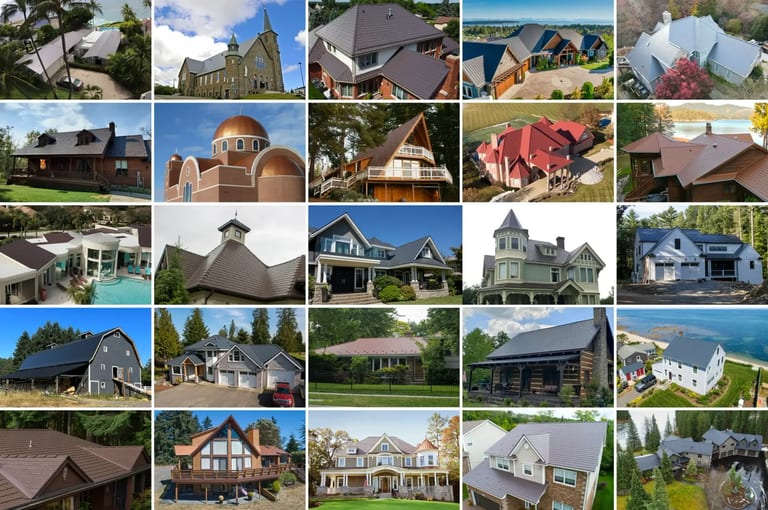
The best type of metal roofing depends on the look you want, because Interlock builds every profile on the same high-performance system. Choose Slate or Mediterranean Tile to mimic stone and clay, Cedar Shingle or Shake for the look of wood, Standing Seam for clean modern lines, or Solid Copper for a premium living finish. All are aircraft-grade aluminum (except copper), four-way interlocked, and backed for a lifetime.
Interlock makes six aluminum and copper roofing profiles — Slate, Cedar Shingle, Cedar Shake, Mediterranean Tile, Standing Seam, and Solid Copper. All share the same engineering: lightweight aluminum (0.41–0.59 psf), a four-way mechanical interlock, a PVDF Alunar® finish, UL 2218 Class 4 impact resistance, and a lifetime warranty.
"Metal roofing" isn't one product — it's a family of profiles, and the right one for your home is mostly a question of the look you love.
The good news is that with Interlock you don't trade style for performance. Whether you choose the look of slate, cedar, clay tile, or a clean standing seam, every profile is built on the same engineering: aircraft-grade aluminum, a four-way mechanical interlock, and the PVDF Alunar® cool-roof coating. So the decision is aesthetic first, and you keep the same lifetime durability either way.
Below is a tour of all six Interlock profiles, what each one imitates, and the verified specs they share — drawn from Interlock's ICC-ES evaluation report (ESR-1790) and product catalog. For a closer visual look at each style side by side, see our profile guide to diverse metal roof styles.
What is the best type of metal roofing for my home?
The best type of metal roofing depends on the look you want, because Interlock builds every profile on the same high-performance system. Choose Slate or Mediterranean Tile to mimic stone and clay, Cedar Shingle or Shake for the look of wood, Standing Seam for clean modern lines, or Solid Copper for a premium living finish. All are aircraft-grade aluminum (except copper), four-way interlocked, and backed for a lifetime.
Why Aluminum Is the Foundation of Every Profile
Almost every Interlock profile is cold-press-formed from aircraft-grade aluminum — alloy 3105-H24 or 3003-H24, complying with ASTM B209. Aluminum matters for two reasons. First, it will not rust or corrode the way steel does when a coating is scratched, which is why it's the material of choice for coastal and high-humidity homes. Second, it's extraordinarily light: an Interlock shingle installs at about 0.41 psf and a tile panel at 0.59 psf, so it adds almost no load to your structure and can usually go over an existing roof. Every panel is then locked to its neighbors on all four sides and finished in the PVDF Alunar® coating on both faces.
Interlock Slate: The Look of Quarried Stone, Without the Weight
Interlock Slate captures the dimensional look of natural slate while removing its biggest drawbacks — weight, cracking, and splitting. Real slate is heavy enough to require structural reinforcement; Interlock's aluminum version removes that need entirely. It's naturally resistant to fire, carries UL 2218 Class 4 hail-impact testing (the highest rating available), uses the four-way interlocking connection, and is backed by the lifetime limited warranty. For homeowners drawn to a classic stone roof, it's the look and longevity without the structural cost.
Cedar Shingle & Cedar Shake: Wood Grain That Never Rots
Both cedar-look profiles are embossed with a heavy wood grain, then interlocked four ways and fastened to the deck. Because they're aluminum under the Alunar® finish, they deliver the warmth of cedar with none of the maintenance — no curling, cracking, rotting, or splitting, and no fire risk. They're high-velocity-wind tested and carry the same UL 2218 Class 4 impact rating. If you love the texture of a wood roof but not the upkeep or the fire concern, the Shingle and Shake profiles are the answer.
Mediterranean Tile & Standing Seam
Mediterranean Tile mimics the barrel profile of clay or concrete tile at roughly 70 lbs per 100 sq. ft. — about 96% lighter than concrete tile — using a hidden-fastener panel for a clean finish. Standing Seam delivers the crisp, modern lines of architectural metal: weathertight interlocking panels that are mechanically locked, with the protective coating on both sides. Both are solar compatible and, like every Interlock profile, carry the lifetime limited warranty.
"Workmanship and roof quality were excellent and the metal tiles look amazing." — Julio Leon & Agnieszka Glebocka, Madison, Wisconsin · Installed October 2022 · Verified GuildQuality review
Solid Copper and the Aluminum-vs-Copper Question
For most homes, aluminum is the ideal choice: light, corrosion-proof, available in a wide palette of Alunar® colors, and the same alloy proven from coastal Florida to the Antarctic Plateau. Solid Copper is the premium option — a living metal that develops a natural patina over decades and becomes a true architectural statement. Both share Interlock's interlocking engineering and lifetime backing; the choice comes down to budget (see our comparison of metal roof versus shingle costs) and whether you want a painted finish (aluminum) or an evolving natural one (copper).
How to Choose — and What They All Share
Start with the look you want, then let the shared engineering reassure you that performance is a constant. Every Interlock profile is lightweight, four-way interlocked, UL 2218 Class 4 impact-rated, finished in an energy-efficient Alunar® coating, and covered by the Guardian Lifetime Limited Warranty — the same long-term value we break down in why an Interlock roof is a great investment. The only real variables are appearance and material (aluminum vs. copper).
Frequently Asked Questions
What is the best type of metal roofing for my home?
It's primarily an aesthetic choice. Interlock's Slate, Cedar Shingle, Cedar Shake, Mediterranean Tile, Standing Seam, and Solid Copper profiles all share the same engineering, so pick the look you love and you keep the same lifetime durability.
Is aluminum or copper better for a roof?
Aluminum suits most homes: lightweight, corrosion-proof, and available in many colors. Copper is a premium living metal that patinas over time. Both use Interlock's four-way interlock and carry the lifetime warranty.
Are Interlock metal roofs heavy?
No — they're exceptionally light. An aluminum shingle installs at about 0.41 psf and a tile panel at 0.59 psf, roughly 96% lighter than concrete tile, so they typically add no structural load and can go over an existing roof.
Do all the profiles resist hail and fire?
Yes. Every Interlock profile carries UL 2218 Class 4 impact resistance — the highest hail rating available — and aluminum is naturally fire-resistant, achieving a Class A fire classification in tested assemblies (ICC-ES ESR-1790).
Can I put solar panels on any profile?
Yes. Interlock profiles are solar compatible and engineered to outlast a typical PV array. Standing Seam is especially popular for solar because panels can clamp to the seams without penetrations.
Which profile looks most like a traditional roof?
Slate and Mediterranean Tile mimic stone and clay; Cedar Shingle and Shake reproduce wood grain. Each gives a traditional appearance with aluminum durability underneath.
Explore Interlock Metal Roofing
Last updated June 9, 2026