
Explore Diverse Metal Roof Styles for Your Home
Quick Answer
Metal roof styles fall into two questions: the metal and the profile. The metals are aluminum (30–70+ years, rust-proof, lightweight), steel (40–60 years, heavier, can rust if scratched), and copper (100+ years, premium, patinas). The profiles mimic slate, cedar shake, shingle, Mediterranean tile, or modern standing seam. Interlock builds every profile from rust-proof aluminum (or solid copper) with the same lifetime-grade engineering, so you choose the look and keep the performance.
Interlock builds five distinct roof styles — Slate, Cedar Shingle, Shake, Mediterranean Tile, and Standing Seam — from a single engineered platform: aircraft-grade aluminum, a four-way mechanical interlock, the Alunar® PVDF coating, and a transferable Lifetime Limited Warranty. The style changes; the specs underneath don't.
"Metal roofing comes in many styles" is technically true and not very useful. What actually matters is which specific profiles a manufacturer builds, what they're made of, and whether the look you want comes with real engineering behind it.
Interlock makes five profiles, and every one of them shares the same foundation: aircraft-grade aluminum formed into a panel that locks to its neighbors on all four sides, finished in the proprietary Alunar® coating, and backed by the same lifetime warranty. Here's how the five compare, and how to match one to your home.
What metal roof styles does Interlock make?
Interlock offers five aluminum roofing profiles — Slate, Cedar Shingle, Shake, Mediterranean Tile, and Standing Seam — each engineered from aircraft-grade aluminum with a four-way mechanical interlock, the Alunar® PVDF coating, and a UL 2218 Class 4 impact rating. The profile changes the look; the underlying system, wind rating, and warranty stay the same across all five.
Slate: The Look of Stone Without the Weight
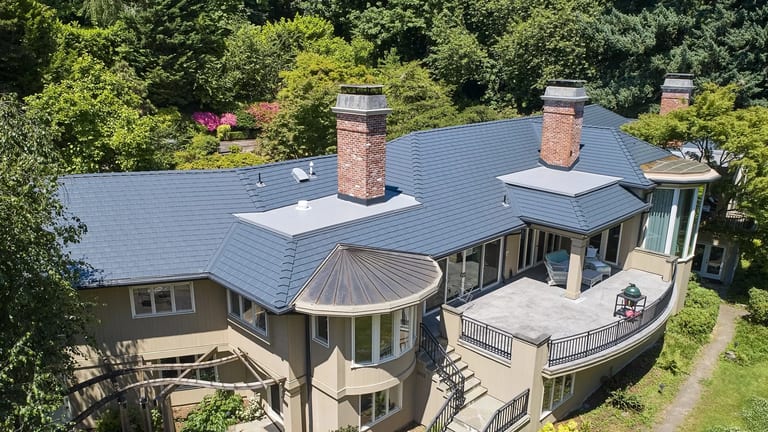
Interlock's Slate profile reproduces the layered, dimensional shadow lines of natural slate roofing — a material that traditionally runs 800–1,500+ lbs per square and is prone to cracking and slipped tiles as fasteners age. At roughly 0.41–0.59 psf, the aluminum version delivers the same visual depth at a fraction of the weight, with none of the freeze-thaw cracking that shortens the life of real stone slate. It suits colonial, traditional, and European-influenced homes.
Cedar Shingle and Shake: Wood's Texture, None of Its Problems
Real cedar shingles and shakes look warm and natural but come with real liabilities: they rot, split, attract pests, and carry a real fire risk unless specially treated. Interlock's Cedar Shingle and Shake profiles reproduce that grain and texture in aluminum, so the look survives decades of weather that would degrade actual wood. The Cedar Shingle profile is versatile enough to clad exterior walls as well as the roof, letting one system define a home's entire envelope. Both suit craftsman, cottage, and rustic architecture.
Mediterranean Tile: Barrel Curves Without the Crack Risk
Clay and concrete barrel tile define Spanish and Mission-style homes, but the material is heavy, brittle, and prone to cracking underfoot or under hail. Interlock's Mediterranean Tile profile forms the same curved, layered look in aluminum — UL 2218 Class 4 rated against impact — so the silhouette survives hail and foot traffic that would shatter real tile.
Standing Seam: Clean Lines for Modern Homes
Standing Seam trades ornamental texture for smooth, vertical panel lines — the classic choice for modern, contemporary, and farmhouse-modern architecture. It's also the profile best suited to solar: its raised seams let mounting clamps grip the roof with no penetrations at all, keeping the surface watertight while carrying a panel array.
One System Underneath Every Style
Whichever profile you choose, the engineering doesn't change. Every Interlock panel is aircraft-grade aluminum, locked to its neighbors with a concealed four-way interlock, finished in the Alunar® PVDF coating (solar reflectance 0.25–0.55, warranted 40 years), rated UL 2218 Class 4 for impact, and tested and warranted to 120 mph wind. All five are backed by the same transferable Guardian Lifetime Limited Warranty — so choosing a style is a matter of look, not a trade-off in performance.
Homeowners notice that curb-appeal payoff immediately. As one Marysville, Washington customer put it: "Neighbors in Marysville, WA are praising how great our Interlock Metal Roofing (PNW) Inc. Metal Shingles look, and we rated the entire experience the highest possible."
"Neighbors in Marysville, WA are praising how great our Interlock Metal Roofing (PNW) Inc. Metal Shingles look, and we rated the entire experience the highest possible." — Doug & Joelle Jewell, Marysville, Washington · Installed November 2020 · Verified GuildQuality review
Matching a Profile to Your Home's Architecture
Slate suits traditional, colonial, and European-style homes. Cedar Shingle and Shake fit craftsman, cottage, and rustic designs. Mediterranean Tile complements Spanish and Mission architecture. Standing Seam belongs on modern, contemporary, and farmhouse-modern homes — and is the natural choice if solar is part of the plan. Request a free quote to see which profile fits your home.
Frequently Asked Questions
What metal roof styles does Interlock offer?
Five profiles: Slate, Cedar Shingle, Shake, Mediterranean Tile, and Standing Seam. Each is formed from aircraft-grade aluminum and shares the same Alunar® coating, interlock design, and warranty.
Which Interlock profile suits a traditional or colonial home?
Slate is the closest match — it reproduces the dimensional shadow lines of natural slate at a fraction of the weight, without the risk of cracked or slipped tiles.
Which profile suits a craftsman or cottage-style home?
Cedar Shingle or Shake. Both reproduce the grain and texture of real wood shakes without the rot, splitting, or fire risk of actual cedar, and the Cedar Shingle profile can clad walls as well as roofs.
Is there a metal option for Spanish or Mediterranean-style homes?
Yes — the Mediterranean Tile profile reproduces the curved barrel-tile look without the weight or cracking risk of real clay or concrete tile.
What's the difference between Standing Seam and the other profiles?
Standing Seam is a smooth, vertical-panel look built for modern and contemporary homes, and its raised seams allow clamp-on solar mounting with no roof penetrations — something the shingle-style profiles don't offer in the same way.
How much do Interlock panels weigh?
Roughly 0.41 to 0.59 psf depending on the profile — light enough that many roofs qualify for an over-existing-roof installation instead of a full tear-off.
Explore Interlock Metal Roofing
Last updated June 9, 2026